
Sandia researchers validate new algorithm for error-resistant quantum computation
The achievement of creating a big, useful quantum computer starts with the success of individual components that will one day compose it. The broader quantum community is
working to develop dozens of distinct critical components, but one includes such unique science that it could be called quantum magic.
A collaboration between Sandia, Quantinuum and the University of California, Davis, has made the American Physical Society’s top open-access journal, Physical Review X. The paper, titled “Experimental demonstration of high-fidelity logical magic states from code switching,” details a new and more efficient algorithm for creating “magic states” that will enable future quantum computers to run programs even if one component fails, a concept called fault-tolerance.
“Magic states solve a problem with quantum computation that seems paradoxical,” researcher Robin Blume-Kohout said. “The error correction protocols that prevent random errors from corrupting a quantum computer’s memory are so effective that they also prevent programmers from performing a critical subroutine called the T gate. Future quantum computers can get around this obstacle by building special magic states within some of their memory qubits that can be used later and on demand to perform T gates.”
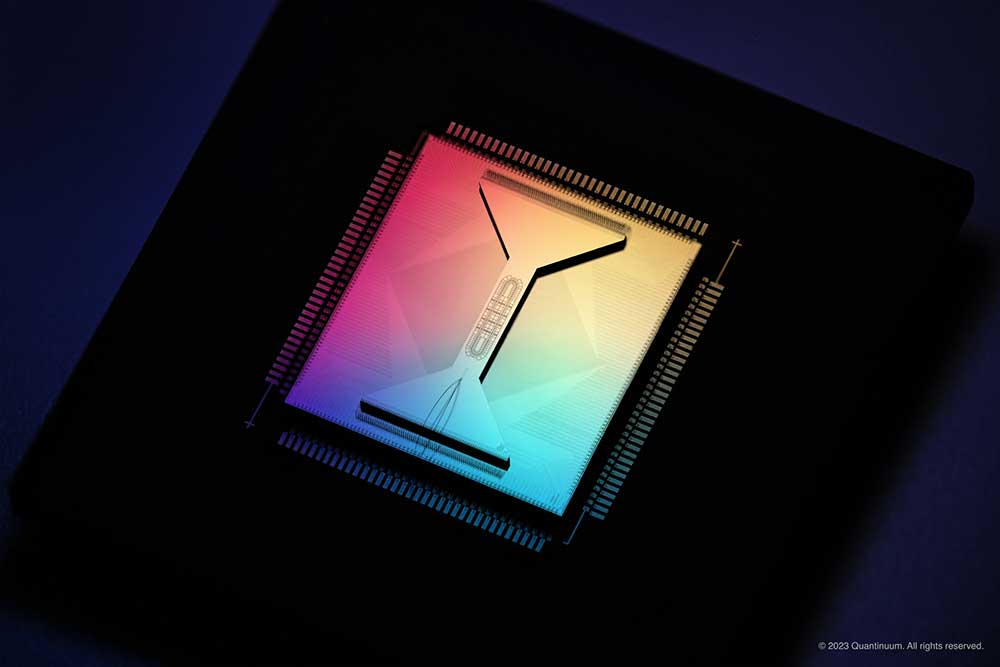
The University of California, Davis, researchers used a method called code switching to prepare a magic state in one error-correcting code, then switch it to another. Quantinuum scientists implemented this method using two different color codes on their H2-1 trapped-ion quantum processor, and Sandia’s Quantum Performance Lab created a customized validation protocol that allowed the team to prove they’d created high-fidelity magic states that only fail 0.01% of the time.
“Quantinuum is advancing the state of the art in quantum computation by exploring new territory. Verifying this code-switching experiment required new techniques, and our partnership with Sandia was essential,” said David Hayes, director of computational design and theory at Quantinuum. “Sandia’s Quantum Performance Lab has world-leading expertise in verifying the faithful operation of quantum processors and provided exactly the prescription we needed to execute this demonstration.”
The science behind the magic
Quantum computers have the potential to implement calculations that would be impossible on conventional supercomputers. They are able to simulate important quantum systems, like catalyst molecules or superconducting materials. With today’s computers, researchers often have to choose between speed or accuracy, but a future fault-tolerant quantum computer could run algorithms that simulate molecules and materials both rapidly and accurately.
One problem lies in the quantum bits, or qubits, the systems are based on. Qubits store quantum information and make up a quantum computer’s memory register. Unlike traditional bits that exist as either a 1 or a 0, qubits can exist in a unique superposition of 0 and 1. This is a totally new state of existence that enables unique and complex calculations, but it leaves them susceptible to a high risk of errors. During calculations, researchers must correct these errors along the way by encoding each computational or “logical” qubit into many physical qubits, and then monitoring them to detect errors. This protects the information from errors but also from the programmer, which is a huge challenge.

A magic state is a particular superposition state into which a qubit can be initialized. It can be difficult to prepare a magic state, but once accomplished, it becomes very useful in calculations. Robin said, “It’s like a $100 gift card that you can redeem for cool stuff whenever you want. Specifically, the quantum computer’s programmer can ‘redeem’ it for a special logic operation, the T gate, that is necessary from time to time in any useful quantum program.”
Future quantum calculations may take hours or days to run. If a qubit experiences an error, it can ruin the entire computation and force the user to start over. Efficient, high-fidelity magic states enable quantum computers to reliably execute operations that cannot be performed directly. The research conducted by Sandia and its partners has now demonstrated a method for achieving a full set of error-resistant operations more efficiently using magic states.
Sandia’s values make magic possible
Sandia is well-positioned to explore quantum computing for critical mission areas in national security with its Quantum Demonstration Facility. Quantum computing is a high-risk but high-reward technology, so researchers’ deep understanding of its challenges and capabilities is necessary for its advancement.
Sandia has historically valued the importance of tackling engineering challenges to prepare for future national security needs. This has attracted and empowered a strong team of quantum experts who are dedicated to developing bleeding-edge technology.
“We have a world-class group at Sandia that thrives on successful collaboration with industry and academia,” said Tzvetan Metodi, manager of quantum computer science at Sandia. “Our partnership efforts support full end-to-end design of quantum computing systems, from the physical qubits through architectures and applications.”
By strengthening these collaborative efforts, Sandia enables a future where the full power of quantum computing can be harnessed.