
Machine-learning process can help make electricity production more efficient

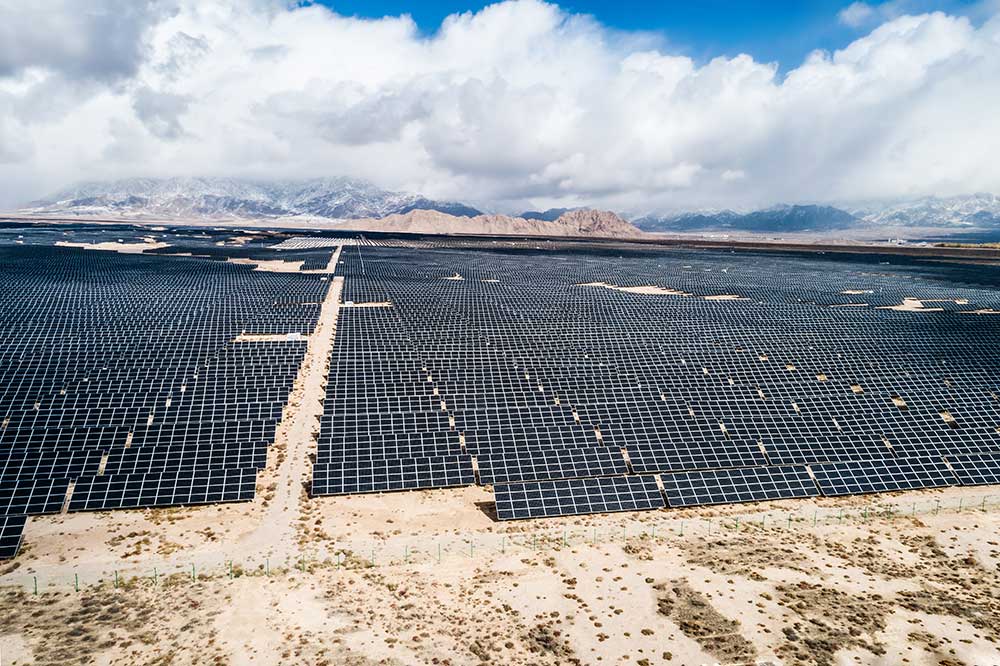
For solar farms that rely on the sun to generate power, rain or even a cloudy day can really cast a shadow over this natural energy resource. But Sandia engineers may have a way to keep power flowing from these large solar harvesters and cut costs for energy companies.
Engineer Dan Riley and his team have patented a machine-learning method that finds the brightest point in the sky so that photovoltaic arrays mounted on single-axis trackers can collect the most solar energy.
“When the sun is visible, we just point the tracker toward the sun, but if the sun is obscured by a cloud, then the utility of pointing at the sun is greatly reduced, and in fact it’s often more advantageous to not point at the obscured sun,” Dan said.
On cloudy days, finding the brightest spot in the sky to harvest the most solar energy can be tricky. Right now, photovoltaic array operators input the sun’s path into the software controlling the angle of the solar panels, so they move and point at the sun all day long. But in cloudy conditions, the brightest spot is not necessarily where the sun is.
Dan’s method uses machine learning to find the best spot by training an algorithm using thousands of sky images taken by a fisheye-lens camera. These images are compared to images on any given day and used to help point the photovoltaic panels at the likely brightest spot in the sky.
“We don’t natively have a good feeling for the amount of energy that you could get from a bright pixel, and part of that is the camera’s limitations,” Dan said. “It’s not really a calibrated device for determining the amount of solar radiation in any particular plane. The machine-learning algorithm, in our case a convolutional neural network, is trained to find the brightest path in a sky image. This training from sky images allows us to then get the same information as we would from a very precise and expensive sensor.”
The initial project, funded by DOE Solar Energy Technologies Office, ended in September 2024. Dan and his team are now working on timing the tracker to move for peak efficiency.
“The next research step is determining not only where to move the tracker rotation angle to capture the most solar energy but when to move to capture the most energy,” he said. “Since single-axis trackers have a relatively slow movement rate, it is important that they only point away from the sun when the sun is obscured by a cloud. They should be ready to quickly move to point at the sun when it is no longer obscured.”
If companies can build upon the technology developed at Sandia, the efficiencies realized would reduce the number of photovoltaic panels, the land needed and the amount of support equipment, thereby reducing the cost to generate the same amount of energy.
“By increasing the energy generated by photovoltaic systems, we increase the efficiency of the system. By increasing the energy generated during cloudy periods, we also reduce variability,” Dan said. “As single-axis tracker-mounted PV becomes a larger component of the U.S. energy mix, increasing the energy generated by these systems may allow for smaller PV plants, reduced capital expenditure on new plants, and ultimately, lower energy costs.”
Businesses have the opportunity to license Sandia’s Single Axis Tracking via Sky Imaging and Machine Learning patent and forge a partnership with the Labs.