
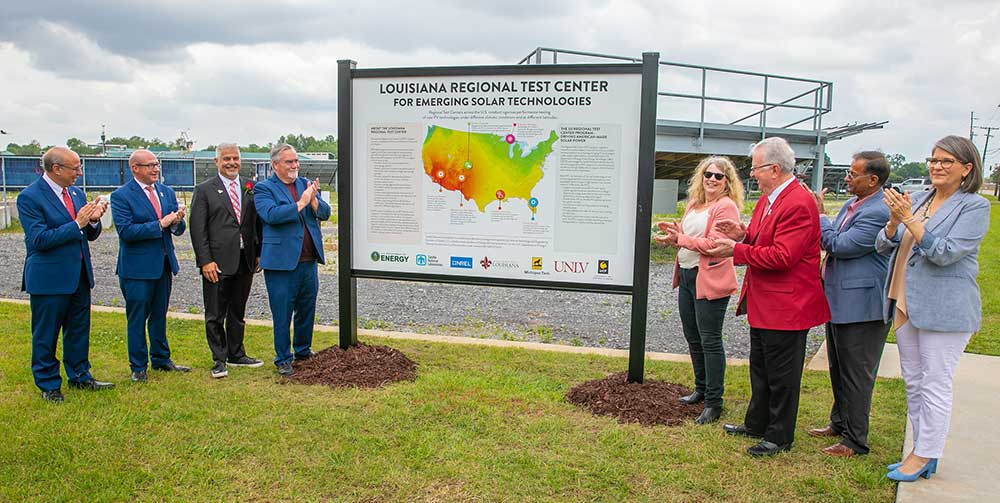
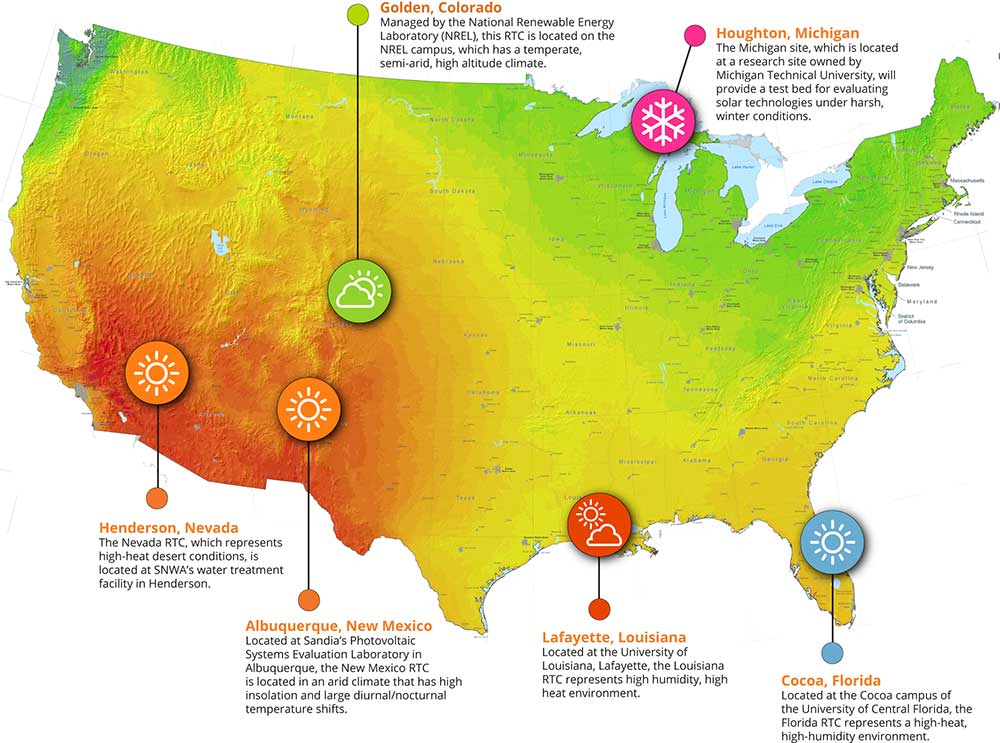
Sandia has designated the University of Louisiana at Lafayette as its sixth Regional Test Center for Emerging Solar Technologies.
The Regional Test Center program provides a state-of-the-art technical platform, enabling performance studies of emerging photovoltaic technologies across multiple climates.
Established by the DOE Solar Energy Technologies Office, these elite centers allow for rigorous evaluation of proprietary technologies under realistic field conditions to support commercialization of high-efficiency solar technologies, such as panels, as well as new applications, such as roof-integrated solar.
Each center has a common infrastructure, including world-class meteorological instrumentation, high-resolution monitoring equipment and operating protocols to ensure data quality. Since the program’s inception, the Regional Test Centers have supported more than 30 companies.
“The RTC program supports the development and validation of U.S.-made solar products and helps ensure U.S. research and development leadership in solar energy research and deployment,” program lead Laurie Burnham said.
The announcement was made April 25 during a ceremony at University of Louisiana-Lafayette to dedicate Antoun Hall, a 45,000-square-foot facility housing the university’s Solar Energy Lab that has the tools and technical capabilities to support the new center. Located on a six-acre solar field adjacent to Antoun Hall, the university’s Research Park, the center will support industry-funded studies as well as research. Sandia chose the site for its high heat and humidity, as well as the location’s potential for severe weather events, such as hurricanes.
Sandia is also partnering with the university on the DOE-funded project, “Strategies and Technologies for Operationally Resilient and Maximally available Solar,” or STORMS, which aims to develop tools and best practices for predicting, mitigating and responding to extreme weather.
Sandia and University of Louisiana researchers will evaluate the resilience of solar racks and fasteners to hurricane-force winds to support best practices and new codes and standards. As a parallel effort, Sandia will expose electrical connectors to the high heat and humidity at the Louisiana center, comparing results with a matched experimental setup at Sandia.
University of Louisiana-Lafayette said it will also leverage the Regional Test Center to support workforce development for those choosing a career in the photovoltaic industry. The country’s largest manufacturer of solar components, First Solar, plans to begin operations at its New Iberia, Louisiana, site by the end of 2025, and will need a well-trained workforce. Many of those workers are expected to receive training through the university.
“University of Louisiana has the passion, the technical excellence and the dedicated staff needed to support this partnership; Sandia has the know-how and technical capabilities to drive change,” Laurie said. “Together, we will help grow the supply of American energy, drive innovation in the solar sector and expand opportunities for the students and workers of Louisiana.”
Learn more about Sandia’s Regional Test Center facilities and capabilities and the University of Louisiana-Lafayette’s solar research, training and curriculum.