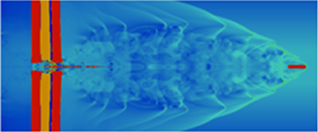
Albany is an implicit, unstructured grid, finite element code for the solution and analysis of partial differential equations. Albany is the main demonstration application of the AgileComponents software development strategy at Sandia. It is a PDE code that strives to be built almost entirely from functionality contained within reusable libraries (such as Trilinos/STK/Dakota/PUMI). Albany plays a large role in demonstrating and maturing functionality of new libraries, and also in the interfaces and interoperability between these libraries. It also serves to expose gaps in our coverage of capabilities and interface design.
In addition to the component-based code design strategy, Albany also attempts to showcase the concept of Analysis Beyond Simulation, where an application code is developed up from for a design and analysis mission. All Albany applications are born with the ability to perform sensitivity analysis, stability analysis, optimization, and uncertainty quantification, with a clean interfaces for exposing design parameters for manipulation by analysis algorithms.
Albany also attempts to be a model for software engineering tools and processes, so that new research codes can adopt the Albany infrastructure as a good starting point. This effort involves a close collaboration with the 1400 SEMS team.
The Albany code base is host to several application projects, notably:
- LCM (Laboratory for Computational Mechanics) [PI J. Ostien]: A platform for research in finite deformation mechanics, including algorithms for failure and fracture modeling, discretizations, implicit solution algorithms, advanced material models, coupling to particle-based methods, and efficient implementations on new architectures.
- QCAD (Quantum Computer Aided Design) [PI Nielsen]: A code to aid in the design of quantum dots from built in doped silicon devices. QCAD solves the coupled Schoedinger-Poisson system. When wrapped in Dakota, optimal operating conditions can be found.
- FELIX (Finite Element for Land Ice eXperiments) [PI Salinger]: This application solves variants of a nonlinear Stokes flow for simulating the evolution of Ice Sheets. In particular, it conducts climate modeling of the Greenland and Antarctic Ice Sheets for Sea-Level Rise. Will be linked into ACME.
- Aeras [PI Spotz]: A component-based approach to atmospheric modeling, where advanced analysis algorithms and design for efficient code on new architectures are built into the code.
In addition, Albany is used as a platform for algorithmic research:
- FASTMath SciDAC project: We are developing a capability for adaptive mesh refinement within an unstructured grid application, in collaboration with Mark Shephard’s group at the SCOREC center at RPI.
- Embedded UQ: Research into embedded UQ algorithms led by Eric Phipps often uses Albany as a demonstration platform.
- Performance Portable Kernels for new architectures: Albany is serving as a research vehicle for programming finite element assembly kernels using the Trilinos/Kokkos programming model and library.
The FASTMath SciDAC Institute develops and deploys scalable mathematical algorithms and software tools for reliable simulation of complex physical phenomena and collaborates with application scientists to ensure the usefulness and applicability of FASTMath technologies.
FASTMath is a collaboration between Argonne National Laboratory, Lawrence Berkeley National Laboratory, Lawrence Livermore National Laboratory, Massachusetts Institute of Technology, Rensselaer Polytechnic Institute, Sandia National Laboratories, Southern Methodist University, and University of Southern California. Dr. Esmond Ng, LBNL, leads the FASTMath project.
Transforming and decarbonizing the world’s energy systems to make them environmentally sustainable while maintaining high reliability and low cost is a task that requires the very best computational and simulation capabilities to examine a complete range of technology options, ensure that the best choices are made, and to support their rapid and effective implementation.
The Institute for Design of Advanced Energy Systems (IDAES) was originated to bring the most advanced modeling and optimization capabilities to these challenges. The resulting IDAES integrated platform utilizes the most advanced computational algorithms to enable the design and optimization of complex, interacting energy and process systems from individual plant components to the entire electrical grid.
IDAES is led by the National Energy Technology Laboratory (NETL) with participants from Lawrence Berkeley National Laboratory (LBNL), Sandia National Laboratories (SNL), Carnegie-Mellon University, West Virginia University, University of Notre Dame, and Georgia Institute of Technology.
The IDAES leadership team is:
- David C. Miller, Technical Director
- Anthony Burgard, NETL PI
- Deb Agarwal, LBNL PI
- John Siirola, SNL PI
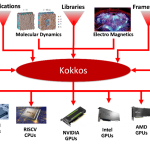
Modern high-performance computing (HPC) architectures have diverse and heterogeneous types of execution and memory resources. For applications and domain-specific libraries/languages to scale, port, and perform well on these architectures, their algorithms must be re-engineered for thread scalability and performance portability. The Kokkos programming system enables HPC applications and domain libraries to be implemented only once, while being performance portable across diverse architectures such as multicore CPUs, GPUs, and APUs.
This research, development, and deployment project advances the Kokkos programming system with new intra-node parallel algorithm abstractions, implements these abstractions in the Kokkos library, and supports applications’ and domain libraries’ effective use of Kokkos through consulting and tutorials. Kokkos is an open-source project in the Linux Foundation, with the primary development support coming from Sandia National Laboratories, Oak Ridge National Laboratory, and the French Alternative Energies and Atomic Energy Commission.
MESQUITE is a linkable software library that applies a variety of node-movement algorithms to improve the quality and/or adapt a given mesh. Mesquite uses advanced smoothing and optimization to:
- Untangle meshes,
- Provide local size control,
- Improve angles, orthogonality, and skew,
- Increase minimum edge-lengths for increased time-steps,
- Improve mesh smoothness,
- Perform anisotropic smoothing,
- Improve surface meshes, adapt to surface curvature,
- Improve hybrid meshes (including pyramids & wedges),
- Smooth meshes with hanging nodes,
- Maintain quality of moving and/or deforming meshes,
- Perform ALE rezoning,
- Improve mesh quality on and near boundaries,
- Improve transitions across internal boundaries,
- Align meshes with vector fields, and
- R-adapt meshes to solutions using error estimates.
Mesquite improves surface or volume meshes which are structured, unstructured, hybrid, or non-comformal. A variety of element types are permitted. Mesquite is designed to be as efficient as possible so that large meshes can be improved.