

Sandia plays a crucial role in developing reliable and secure electronic components, known as microelectronics, that are vital to U.S. nuclear deterrence strategy.
Just as a car needs a dependable engine to function properly, weapons systems rely on trustworthy microelectronics to operate effectively. By providing trusted microelectronics, Sandia helps maintain the integrity of the nuclear deterrent, which underpins U.S. defense strategy and reduces allies’ need to acquire nuclear weapons.
“Sandia’s microelectronics are vital to the country’s national defense strategy,” Microsystems Engineering, Science and Applications Director Reno Sanchez said. “National defense relies on the nuclear deterrent, and nuclear deterrence relies on Sandia’s microelectronics.”
Sandia’s commitment to advancing microelectronics is reflected in its infrastructure and collaborative efforts across various specialized facilities. From the MESA complex to the Center for Integrated Nanotechnologies and the Counterfeit Detection Center, work at each facility is critical to the mission. Coupled with state-of-the-art testing facilities, including the Annular Core Research Reactor, Z machine, and Saturn and HERMES pulsed-power facilities, Sandia is positioned to develop and validate cutting-edge microelectronic technologies that meet the demands of national security.

Sandia’s MESA complex specializes in design and manufacturing of custom microelectronic components tailored to the needs of nuclear deterrence. These components are engineered to perform in extreme conditions and offer power, reliability and radiation hardness necessary for high-consequence systems. MESA functions as a specialized U.S. government foundry, producing advanced microsystems that cannot be manufactured in the commercial sector due to strict security requirements and low production volumes. This ensures the country’s defense systems are equipped with the most reliable technology available.
“MESA is unique in that it is the nation’s only source of trusted strategic rad-hardened microelectronics, and it meets the rigorous demands of our nation’s defense system,” Labs Director Laura McGill said during a news conference on May 14.
Sandia’s expertise spans the entire microelectronics lifecycle, from research and design to manufacturing and testing. Sandia’s commitment to innovation is further strengthened by its partnerships with industry, academia and government, creating a virtuous cycle that enhances national security. Funding from the federal CHIPS and Science Act bolstered these efforts, supporting advancements in semiconductor technologies and strengthening the U.S. semiconductor supply chain.
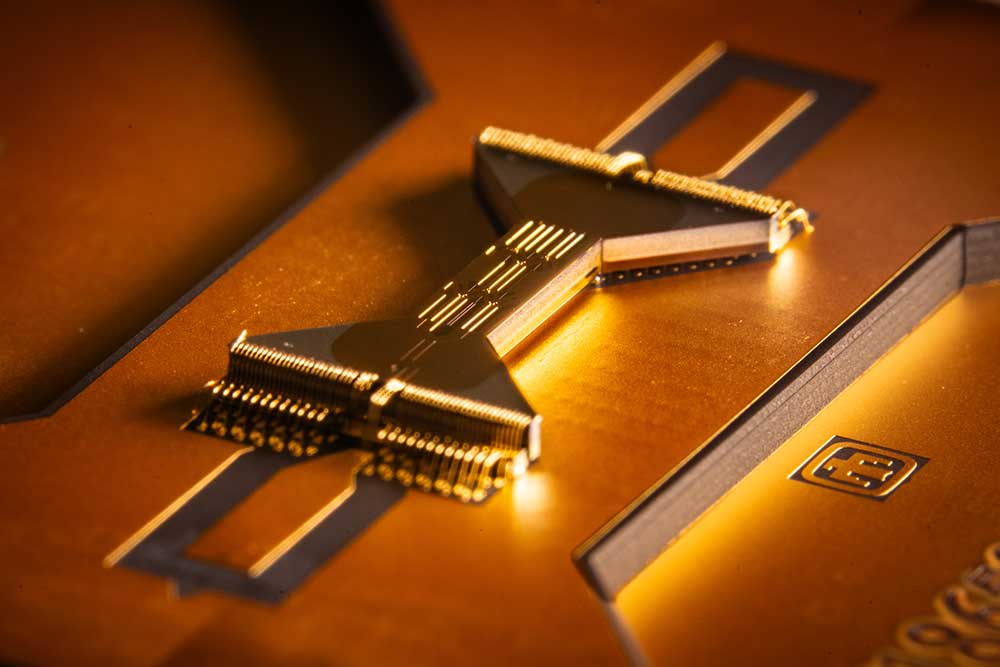
Sandia leads in quantum computing, collaborating with prestigious institutions such as Tufts and Duke universities to develop technologies. Sandia furthers initiatives like the Quantum New Mexico Institute and the Elevate Quantum Tech Hub to foster a robust regional innovation ecosystem.
Sandia operates the Center for Integrated Nanotechnologies, a collaborative facility with Los Alamos National Laboratory. This center specializes in atomic-precision lithography, focused ion-beam implantation and the synthesis of optical and electronic materials, positioning Sandia at the forefront of nanotechnology and quantum science. This facility enhances Sandia’s ability to develop advanced microelectronic components that meet the stringent requirements of national security.
To further ensure the integrity of microelectronics beyond those it produces, Sandia established the Counterfeit Detection Center. Work at this center relies on Sandia’s deep understanding of microelectronic design to assess components at micro and macro levels, detecting counterfeits and verifying the microelectronics supply. Sponsors use Sandia’s expertise and facilities to identify potential vulnerabilities and counter cyber threats, ensuring that all microelectronic systems function as intended and maintain the highest standards of reliability.

Looking ahead, the DOE Office of Science has announced the establishment of three new microelectronics science research centers. Among these, the Microelectronics Energy Efficiency Research Center for Advanced Technologies, or MEERCAT, will focus on energy efficiency by exploring solutions that bridge sensing, edge processing, artificial intelligence and high-performance computing. Sandia will be a founding member of MEERCAT and will lead one of eight energy efficiency-related research projects within the center.
“By leveraging Sandia’s unique facilities and expertise, we are committed to delivering trusted microelectronics that support our national security,” Deborah Frincke, associate Labs director of National Security Programs, said. “From supporting the nuclear deterrent with trusted solutions to pioneering innovations in quantum computing, photonics, microelectromechanical systems, heterojunction bipolar transistors, non-volatile memories, hypersonics, advanced radar and other cutting-edge technologies, Sandia is dedicated to ensuring our nation’s future security.”
As Sandia continues to lead the way in microelectronics innovation, it remains committed to providing the trusted solutions that strengthen U.S. defense strategy and safeguard the nation’s future.
“We will continue to invest in these tools, the processes and our people that regularly produce new patents in these technologies and keep our deterrent at the leading edge,” Laura said during the news conference.
Visit Sandia’s website for more information about microelectronics initiatives.