
Meet the latest Jill Hruby and Truman Fellows
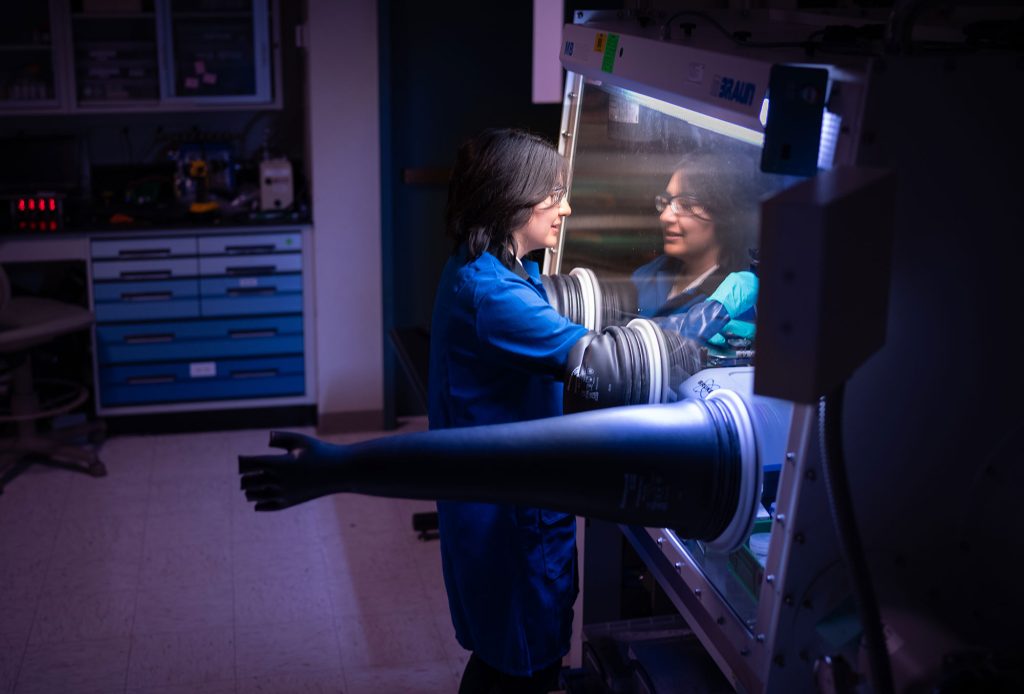
From a middle school electric car challenge to a community college organic chemistry class, Sandia’s newest Jill Hruby and Truman fellows found their way to the Labs through very different paths. But today, they’re tackling some of science’s toughest questions — from battery degradation to quantum computing limits — in support of Sandia’s national security mission, all while building their own path as independent researchers.
Hruby Fellow Maria Kelly
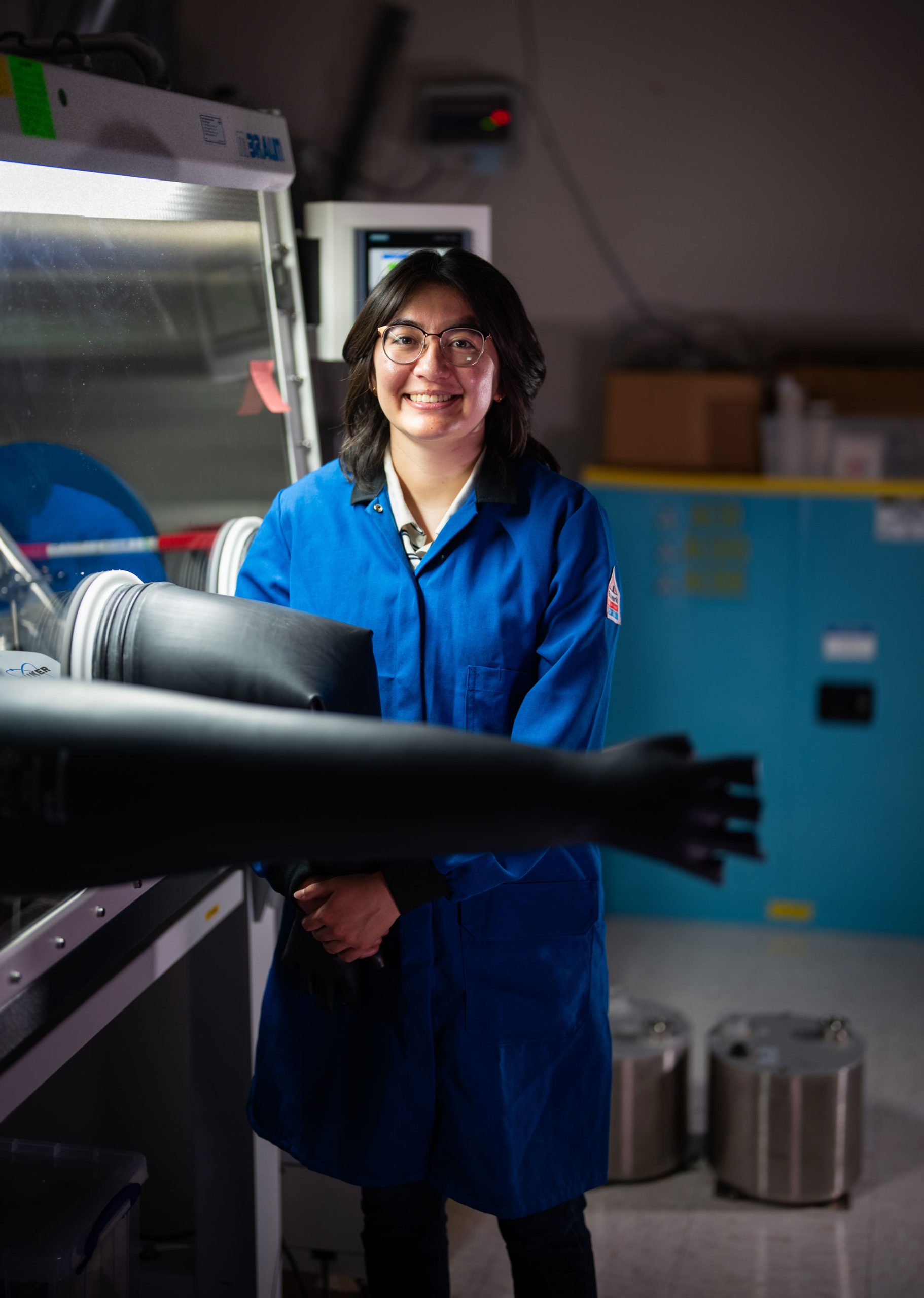
Born and raised in Albuquerque, Maria credits Sandia’s involvement in the community for helping spark her interest in electrochemistry.
“In middle school, I participated in an Alternative Fuels Challenge,” said Maria, a chemical engineer and Jill Hruby fellow. “It was fun to work on this hands-on engineering project with a team and watch our idea come to life. I think that was probably the first time I realized this might be something I wanted to do when I grew up.”
That challenge, now known as The New Mexico Middle School Electric Car Challenge, is one of many Sandia-sponsored educational outreach events around the state.
Years later, Maria secured a year-round undergraduate internship at Sandia, working under chemist Tim Lambert to develop new battery chemistries and materials for hydrogen production.
“It was such a great experience — I learned so much about the role electrochemistry plays in producing and storing energy, and how impactful this work can be in making energy more accessible,” Maria said.
After graduating from the University of New Mexico, Maria completed her doctorate in chemical engineering at the University of Colorado, Boulder.
“I really enjoyed my experiences working with national labs — at Sandia, and the National Lab of the Rockies where I did my Ph.D. work,” Maria said. “As a scientist, it’s motivating to be in an environment where everyone is working toward a shared mission.”
Sandia’s mission-driven work, paired with her experience as an intern during undergrad, fueled her desire to pursue the Hruby fellowship.
“During that internship, I was floored by the amount of trust I was given, just as an undergrad,” she said. “Being able to work independently in the lab and have access to this world-class instrumentation — I knew I wanted to come back.”
And she did. In fall 2025, Maria returned to Sandia as a Hruby fellow.
Maria’s current research centers on how lithium-ion batteries degrade over time — specifically, how corrosion of the current collector accelerates that degradation. She notes that the current collector isn’t as widely studied as other battery materials, but understanding it is a piece of the puzzle in figuring out why batteries fail and how they can be improved to store more energy.
“There’s opportunity in understanding the materials that form the current collectors — under what conditions are they stable, under what conditions are they unstable,” Maria said. “By investigating that fundamental electrochemistry, we can enable some next-generation lithium-ion battery systems,” work that supports energy security by making these systems more reliable.
Maria has been back at Sandia for less than a year but says the fellowship has given her an unmatched opportunity to “learn how to be the principal investigator of a research program with training wheels.”
“You get this amazing autonomy where you have full control over your research funding,” Maria said. “But at the same time, you still get this really incredible support and a lot of external mentorship.” Staff scientists Laura Merrill and Tylan Watkins, both experts in electrochemistry, serve as direct technical mentors on Maria’s fellowship project.
Just as important, Maria notes the bird’s-eye perspective the fellowship has offered her.
“There is so much interesting work happening at Sandia, and this fellowship has allowed me to connect with center directors, division leads and even shadow our Labs director, Laura McGill,” she said. “It’s helped me connect with the greater Sandia network — and in turn, our shared mission.”
Hruby Fellow Morgan Jones
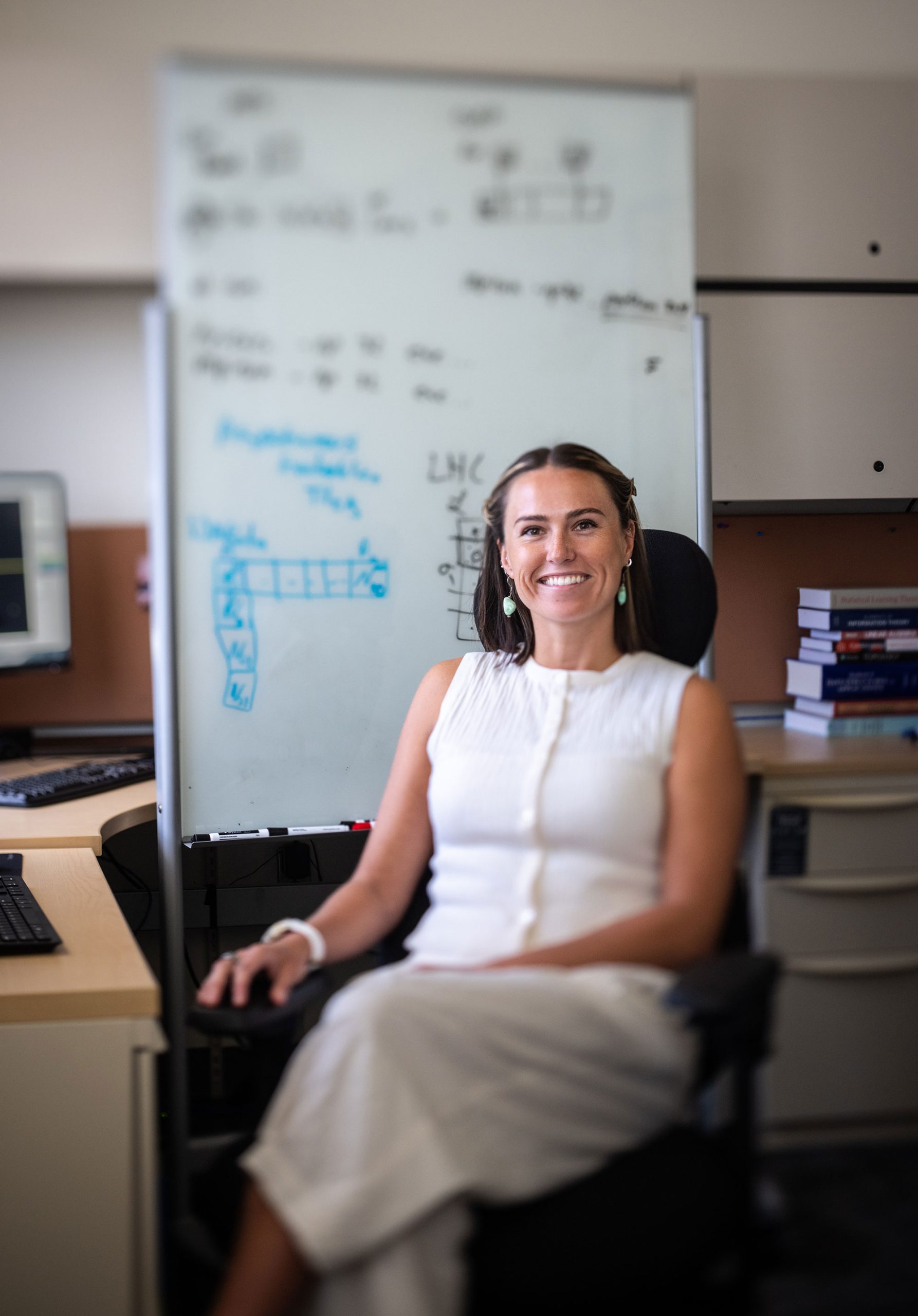
Morgan Jones was a Sandian before she became a Hruby fellow.
In 2019, she was a mechanical engineer working as a technologist with Sandia’s Materials Mechanics and Tribology department, testing the strength and toughness of materials.
Her team would scratch and poke the surface of a material, measuring how much force it took to make a dent or how the metal pushed back. But this work always left Morgan curious about why these materials behaved the way they did.
“I ended up going back to school in 2021 for my Ph.D. so I could figure that out — get to the bottom of why a few of the alloys we were testing were performing so well,” Morgan said.
In 2025, Morgan earned a doctorate in materials engineering from the University of California, Santa Barbara, and applied for the Hruby fellowship.
“I applied because this opportunity offered exactly what I want to do: lead and direct my own research,” she said.
Currently, that research focuses on designing next-generation refractory alloys — structural materials engineered to survive extreme conditions like intense heat, high-speed impacts and harsh environments. These alloys are used in demanding applications like fusion energy systems, hypersonic vehicles and spacecraft, all of which depend on materials that won’t bend, crack or lose their shape under punishing conditions — the level of performance that national security and energy systems require.
“My job as a materials scientist is to discover better alloys — they need to be stronger and more environmentally resistant,” Morgan said. “I use a high throughput thermodynamic approach as my screening tool — basically, scanning the material properties of a large number of new alloy compositions through computer simulations to quickly narrow down which ones are worth a closer look. The way I like to describe it is if you’re looking for a needle in a haystack, this tool is the metal detector. It gets you within the general region of where the needle is. Then I bring in the magnet, a simulation tool called phase field dislocation dynamics. That’s what pulls the needle out. It predicts how well an alloy holds its strength at high temperatures and how it stands up to its environment. Together, they turn a trial-and-error search into physics-based design.”
Today, Morgan’s work is computational — a sharp contrast to the six years she spent as an experimentalist.
“A researcher will typically spend their entire career as a computational scientist or an experimentalist,” she said. “Doing both is rare, and it’s actually a common problem in fundamental research, because the two groups don’t typically speak the same technical language.”
Computational researchers tend to work in the language of energy and atomic-scale mechanisms. Experimentalists work in the language of measurement: stress, strain, force and performance. Both are describing the same material behavior, but the translation between those two descriptions doesn’t happen automatically.
“You really need both perspectives, and they need to work together,” Morgan said. “Especially in materials design, where alloy discovery depends on understanding the mechanisms behind the properties we measure.”
Morgan is fluent in both languages, and she’s not in a hurry to map out where that takes her. Asked what comes after the Hruby fellowship, she said she stopped trying to predict her future a long time ago. “But ultimately, I want to keep chasing the fundamental question of why a material behaves the way it does. That’s what drives me.”
Truman Fellow Niels Kornerup
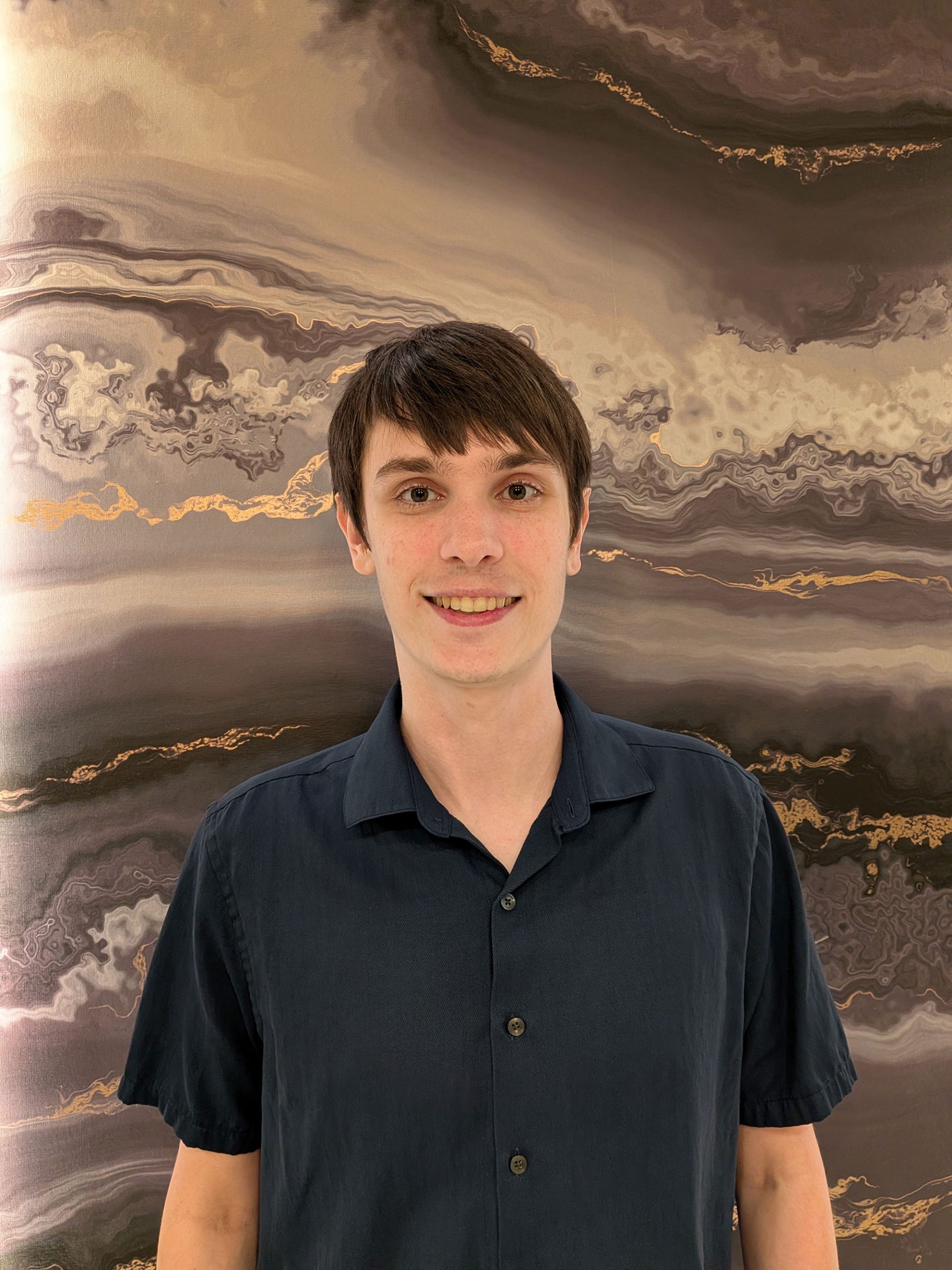
Niels Kornerup, a theoretical computer scientist and Truman fellow, said his love of math and science started early.
“I went to a magnet middle school in Austin, Texas, that specialized in math and science and really fell in love with these fields of study,” Niels said. “I was really into the programming side of robotics. I’d use computers to program LEGO Mindstorm robots and programmed games on my graphing calculator.”
His interest continued to grow in high school, where he was the math and science specialist on his Quiz Bowl team. After learning about theoretical computer science in college, he decided to pursue a degree in this field, which led to a doctorate, which led to the Truman fellowship.
Niels’ research has two components: studying trade-offs between time and memory in computing and studying how energy efficient computing can be. Both help researchers better understand the fundamental limits of what computers can do and at what cost. This research could shape the future of computing and the national security systems that depend on it.
“When looking at trade-offs, I investigate how much memory a computer needs versus how much time it takes,” Niels said. “If you limit a quantum computer’s memory, how much longer does it take to solve a problem? I’m trying to prove these trade-offs mathematically, in ways that apply broadly rather than just to narrow special cases. Understanding these limits helps us see just how efficient — or constrained — computers really are.”
Niels’ work on energy-efficient computing takes laws from physics and applies them to computation. “This work is very interdisciplinary and requires translating ideas between fields,” Niels adds.
The most exciting part of his work, he said, is being the first person to prove something to be true.
“The research I’m doing is proof based, so once I have proof of something, it becomes definitively true, and I find a lot of excitement in trying to come up with things that haven’t been done before,” Niels said. “The proofs I’m referring to here are lower bounds.”
By lower bounds, Niels means mathematical proof that something is impossible past a certain point — for example, proving that a computer can’t solve a problem faster than a certain speed, no matter how clever the approach is. Proving something can’t be done has huge value for researchers, saving them time from trying to do the impossible. But sometimes, while working through one of these proofs, Niels runs into a hiccup — a point where the logic doesn’t quite hold up. Rather than a dead end, these hiccups can sometimes be a clue pointing toward a new way to do the very thing the proof was trying to rule out.
When it comes to his future, Niels says he’s open to staying in the national labs or moving into academia, but in the meantime, he’s learning as much as he can as a Truman fellow.
“This fellowship has given me the space and resources I need to prove new things and advance our knowledge,” Niels said. “In the process, I’m learning how to become a better independent thinker for research — coming up with my own questions and following them through to the point of finding answers.”
Truman Fellow Nicole Torquato
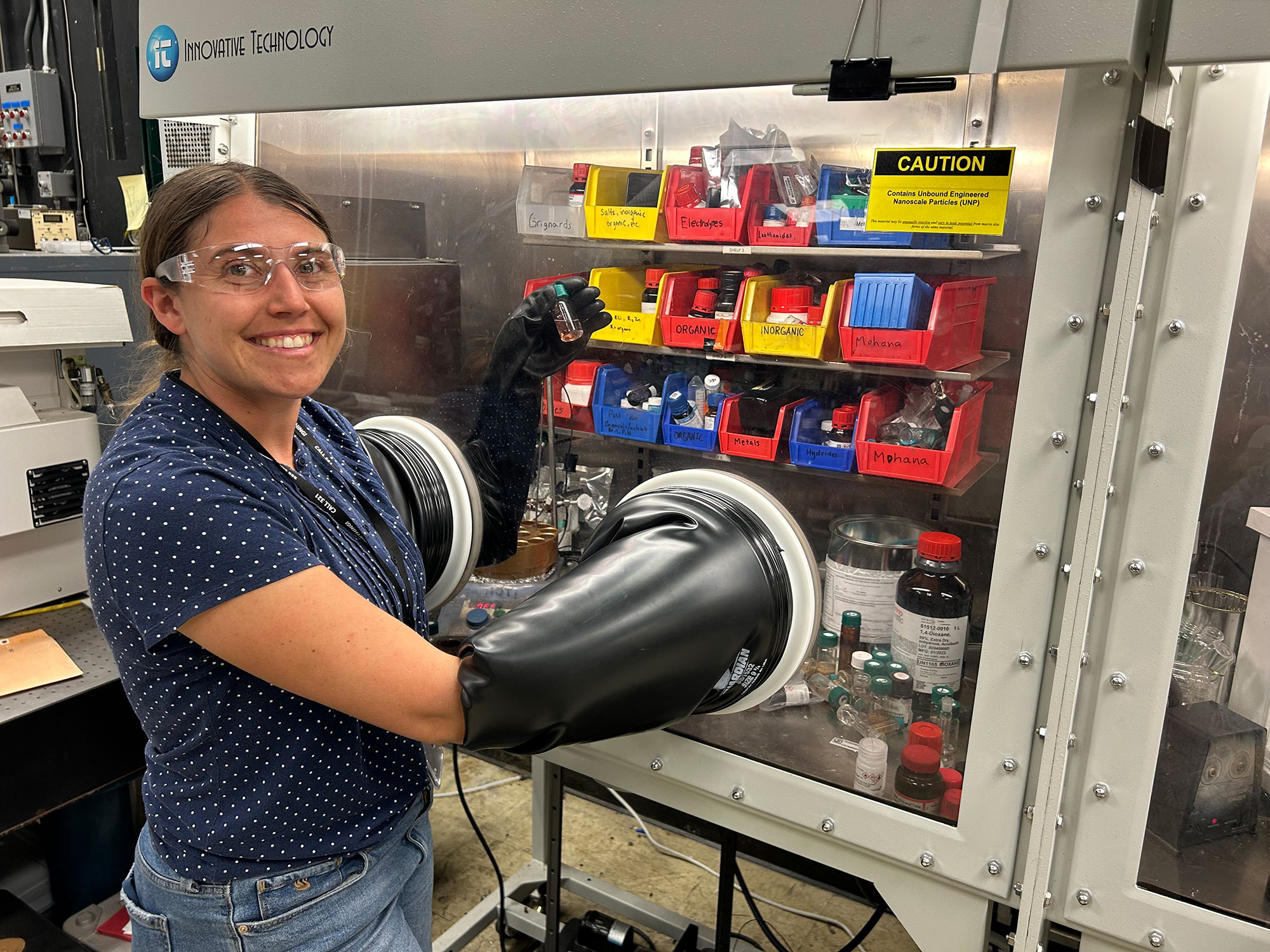
In high school, chemist and Truman Fellow Nicole Torquato says she was more into playing soccer than school. That all changed once she enrolled in her local community college.
“After graduating high school, I wasn’t sure what I wanted to do, so I signed up to take classes at Las Positas College, and that’s where things really started to click,” she said.
The safe, affordable option — as she calls it — turned out to be where Nicole discovered she loved learning. It’s also where she was first introduced to Sandia, and its California campus was just six miles away.
“I did really well in organic chemistry, and my teacher put me in contact with some of the hiring staff at Sandia who helped me secure my first internship,” Nicole said. “I was lucky as a community college student intern to get the experience I did working in a lab because once I transferred to a four-year institute professors wanted to work with me, which isn’t often the case for community college transfer students.”
Nicole went on to earn a doctorate in chemistry from University of California, San Diego, and in 2023, she returned to Sandia as a postdoctoral researcher, studying materials for hydrogen storage and release.
“I loved what I was doing and felt like I had built a strong foundation in hydrogen activation and release, but I wanted to go deeper in chemical reactivity — specifically, developing chemical transformations that upgrade waste-products into higher-value materials,” Nicole said. “So, I decided to apply for the Truman fellowship, which is basically a once-in-a-lifetime opportunity.”
Today, Nicole studies how to take waste — especially CO2 — and turn it into high-value fuel and materials by reacting it with hydrogen, using specially designed catalysts to guide the reaction.
“I want to figure out how to take low-value byproducts and turn them into something valuable, opening up pathways to make fuel and chemicals from sources we don’t traditionally use,” Nicole said. “There is a huge demand for catalyst development for energy applications, both internationally and domestically. It’s exciting to be on the front lines, discovering new solutions that could help address our growing global energy demand.”
Nicole beams when she talks about her research, but her passion doesn’t end there.
“I love science and the work I’m able to do here, but I almost equally love mentorship,” Nicole said, “especially working with community college students.”
Nicole’s experience at Las Positas laid the foundation for where she is today, and she’s committed to paying it forward.
“I’m a huge advocate of community colleges and want to be able to help offer the same opportunities to students that were afforded to me,” she said. “We have a great opportunity to build stronger partnerships with our local community colleges and help students get research experience that can get them to the next level and see what pathways are available to them at a national laboratory.”
These days, Nicole still makes time for soccer — but lucky for us, and the next generation of scientists, she’s just as committed to developing catalysts that could help power the future as she is to guiding students to find their own path to get there.