
Sandia chemist takes home prize at the National Lab SLAM
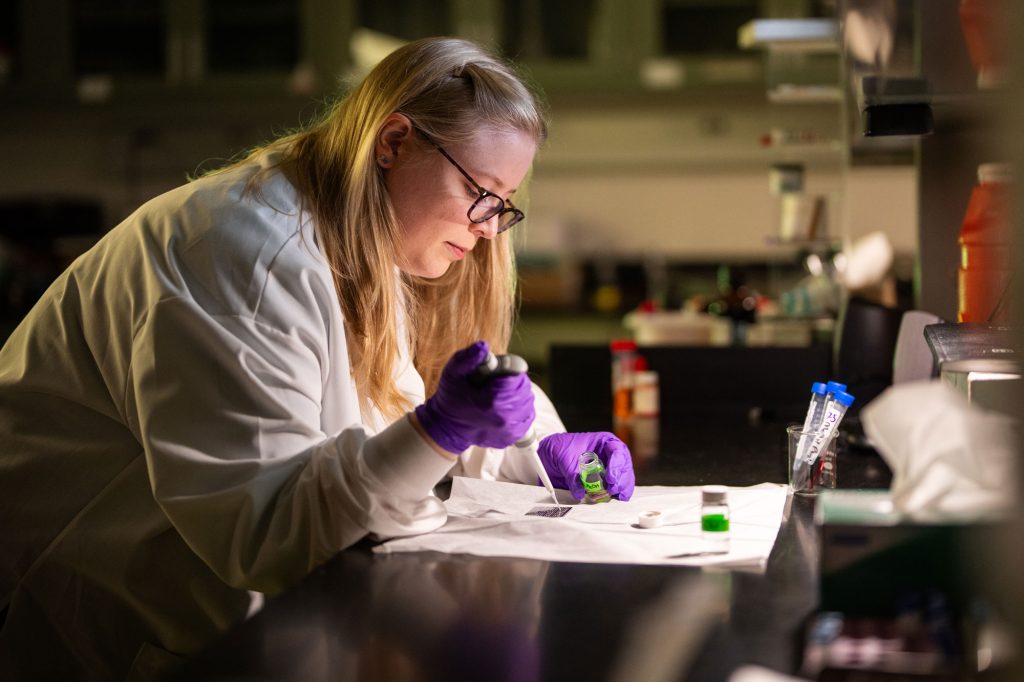
When Sandia chemist Samantha Kruse stepped on stage at the National Lab Research SLAM, she asked the audience to join her in taking a deep breath. As they exhaled, Samantha said, “Over the next three minutes of this presentation, you will inhale roughly 150 individual microplastics.”
The crowd laughed.
“I wasn’t expecting a laugh,” Samantha said. “In my head, this was a pretty serious issue; I wasn’t trying to be funny. But when they laughed, I thought, ‘OK, let’s keep going.’”
She was one of 17 early career scientists competing at the SLAM on April 15. The presenters had three minutes and one slide to showcase their work to an audience of more than 200 policymakers, congressional staff and laboratory representatives on Capitol Hill, plus over 2,000 viewers who tuned in online to watch the livestream.
Samantha took home the award in the Advanced Materials category for her talk, “Deep dive: Revealing the 3D chemistry of microplastics.”
Deep dive
The conversation around microplastics and the dangers they pose to humans and the environment is nothing new, but Samantha’s research takes a deeper dive into the subject — examining the chemicals that exist within the microplastic itself and where those chemicals are located.
“We don’t have a great understanding of what we’re exposed to when we inhale microplastics because microplastics are not just pristine polymers,” Samantha said. “In many cases, microplastics have already been in the environment for months, even years, absorbing harmful pollutants and chemically reacting, which increases their potential toxicity.
“When humans are exposed to microplastics, they’re exposed to all of those additional chemicals too.”
Samantha is working to identify what those chemicals are and where they exist within the microplastic, because, as she said, “Depending on where different pollutants are located inside a microplastic dictates how easily they can be released back into their surroundings which includes the human body.”
Let them eat cake
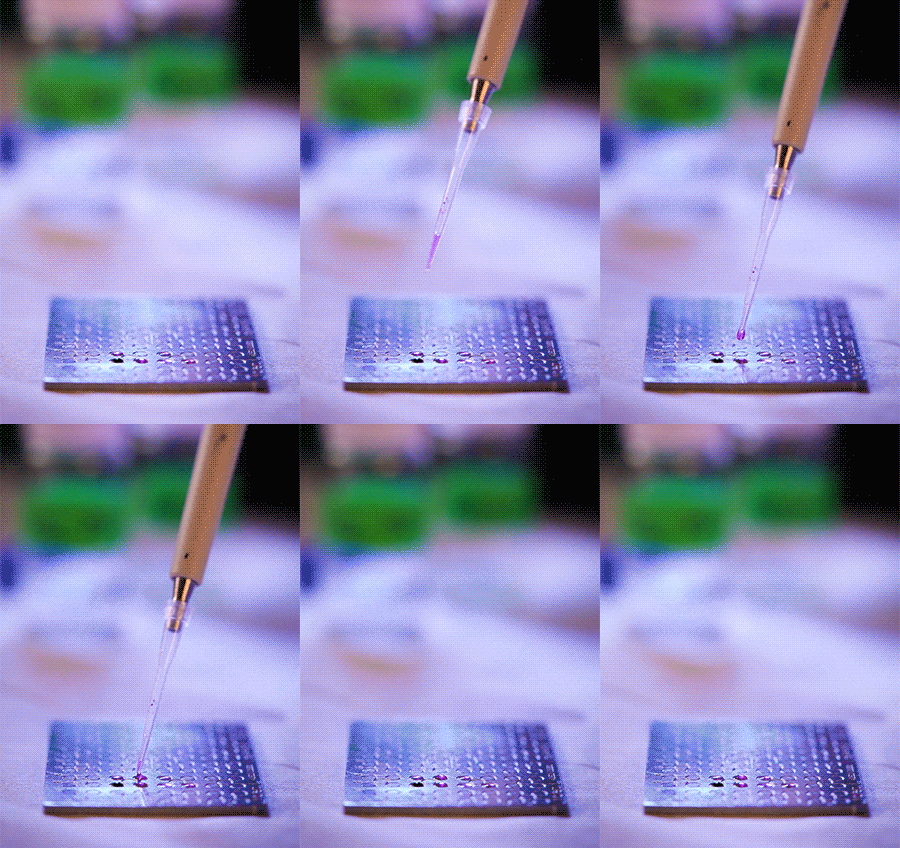
At Sandia, Samantha is developing a method that combines current analytical techniques — which look at high-fidelity spatial and chemical information separately — into one process that she says will improve data quality while saving time and money.
Using an already well-established technique known as Matrix-Assisted Laser Desorption Ionization, or MALDI, and applying a coating of variable thickness, Samantha is able to carefully remove a small sample from a single microplastic to find out what it’s made of.
“The technique I’m working on lets me control how deep the laser goes into the microplastic, so I can create a 3D picture showing where different chemicals are inside it. When I connect this process to an instrument called a mass spectrometer, I get very detailed information about the chemicals present,” Samantha said in her SLAM presentation.
“By looking at the microplastic layer by layer, this method shows which chemicals are near the surface, which are deep inside and which are in between. This helps scientists quickly and thoroughly identify harmful substances in microplastics and understand where they are located. Ultimately, this work will improve our knowledge of the risks microplastics pose to health and the environment.”
Samantha uses a cake analogy to simplify the concept.
“Think of frosting on a cake,” she said. “You have one fork you’re going to use to eat from two different cakes. One cake has a thin layer of frosting; the other has a thick layer. When you dive your fork into the cake with less frosting, you’re going to get more cake, whereas when you use that same fork for the cake with more frosting, you’re going to get less cake.”
Here, the fork is the laser, the frosting is the coating and the cake is the microplastic.
What’s next
The next phase of this work is to take this technique and apply it to actual pollutants within microplastics in simulated environmental situations.
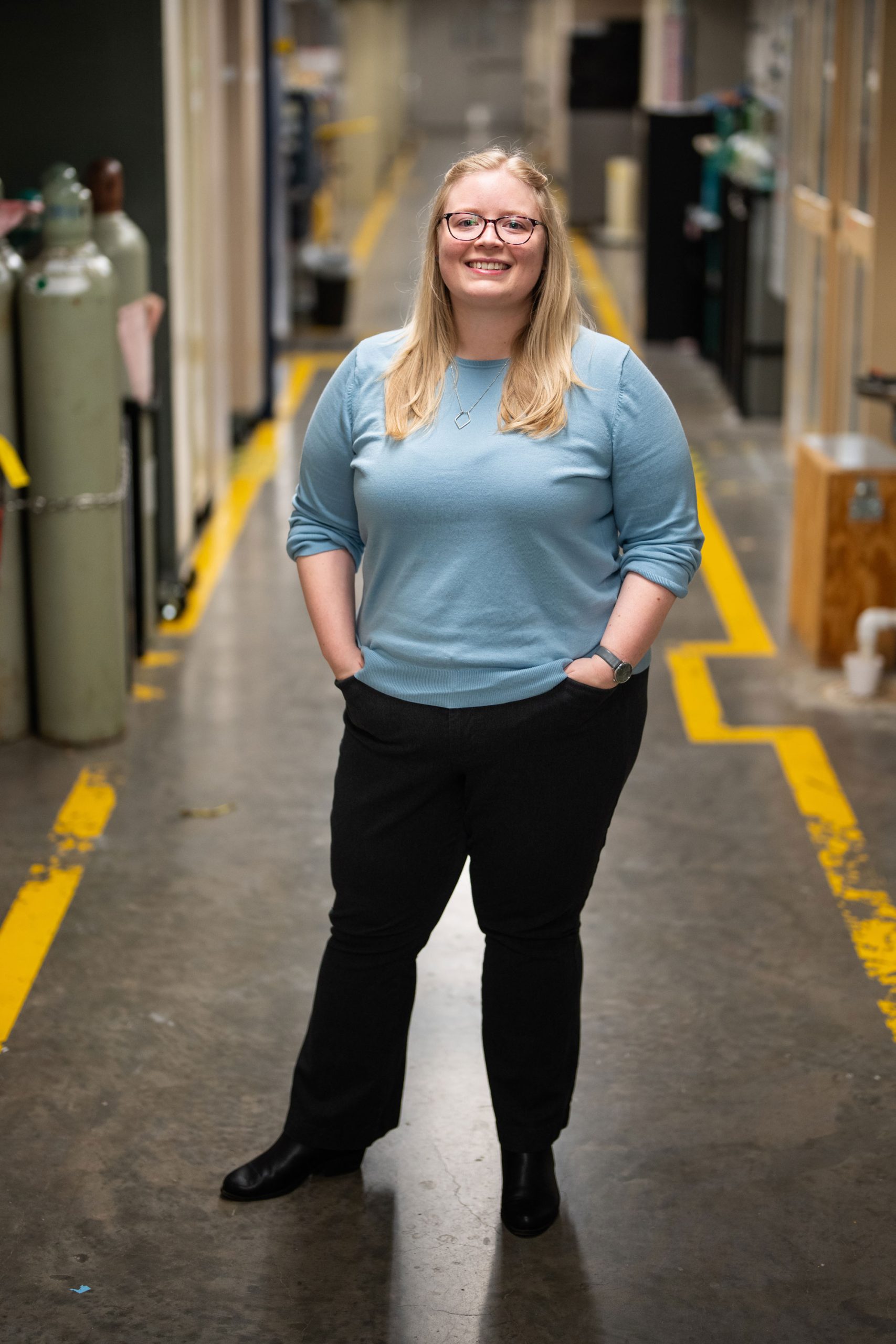
(Photo by Craig Fritz)
“We haven’t measured any real environmental samples of microplastics yet,” Samantha said. “The microplastics we’re currently using in the lab were purchased from a chemical supplier, so they don’t have pollutants in them since they haven’t been exposed to the environment.
“Next, our plan is to apply a mix of pollutants to the microplastic so we can see how they penetrate — how far they absorb or if they stay near the surface. Then we’ll simulate environments to better understand microplastic pollutant exposure in the ocean versus wastewater and so on. There is a lot of variability in these different scenarios that could affect how pollutants are absorbed.”
While her research currently focuses on microplastics, which are environmental pollutants, Samantha believes this work could also be applied to other areas core to Sandia’s mission, specifically how materials in the stockpile age and change over time.
“This research can be applied to any polymeric material,” she said. “When we have materials that age over time, like in the stockpile, it can be hard to determine the chemical reactions that might lead to failure. But having knowledge about where different reaction products are present could give us better information about where these reactions are happening. For example, if there is a reaction occurring only at the surface of a polymer or if there is a reactive species diffusing through the polymer and reacting in other locations. Ultimately, it has the potential to give us a much better understanding of what is causing many of the failures happening in the aging process.”
Inside plastic
As plastics become more commonplace, Samantha believes it is increasingly important to research what that means for our health and the materials themselves.
“Plastics are pervasive and are increasingly replacing other things that used to be made from natural materials,” she said. “Clothes used to be made from natural fibers like cotton or wool, and things in our homes, like tables, used to be made from wood. But now clothes are almost always made of some sort of blend that contains polymers or plastics, and the same goes for furniture.
“This isn’t necessarily a bad thing, but it underscores the importance of testing so we can understand what this means for our health and also the longevity of these items.”