
Can identify presence in 5 minutes
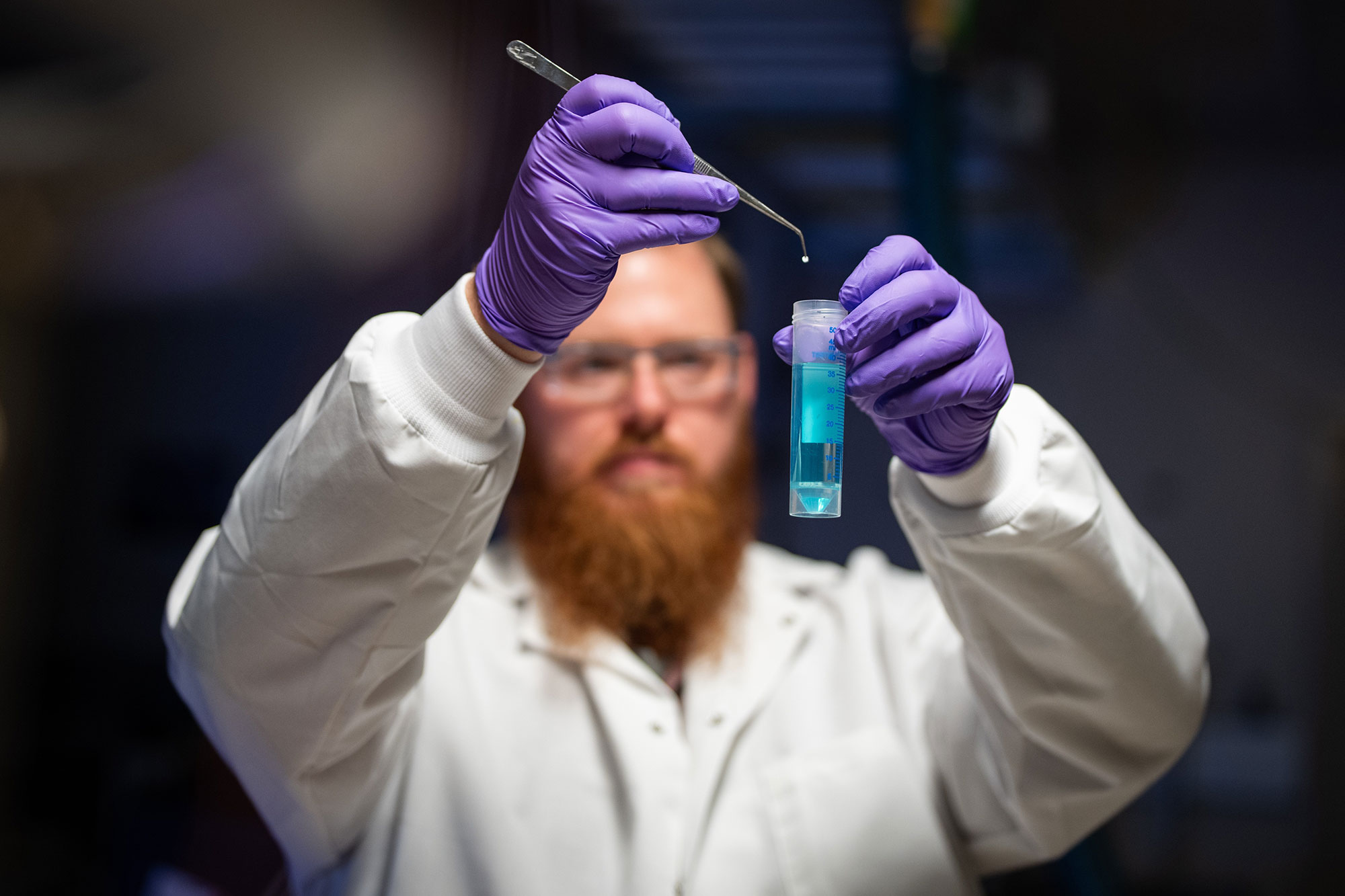
When Sandia scientists Ryan Davis and Nathan Bays set out to find a better way to absorb and degrade PFAS in water sources, they kept running into the same issue: Detecting the chemicals in samples took too long.
So, they came up with their own solution.
They’ve developed a faster, cheaper way to test for PFAS.
The problem of PFAS and solving it
PFAS, or per- and polyfluoroalkyl substances, are commonly called forever chemicals because they don’t break down naturally in the environment. They can move through soil and water and build up in wildlife and humans.
Ryan, a chemist, has spent years developing technologies that can eliminate PFAS on both large and small scales. But that research has been time-consuming. Depending on the concentration, it can take hours to days to detect PFAS in a single sample.
“A common complaint of ours and others who are doing PFAS analysis is that it’s slow and can be costly depending on the technology,” Ryan said.
Traditional testing processes requires repetitive extraction, concentration and processing.
It starts with a liter or more of liquid, suspected to contain PFAS. The liquid is forced through a cartridge to extract the PFAS. The collected PFAS is then added to a smaller volume of water, and the process is repeated with new cartridges until enough PFAS concentrated for detection.
Additionally, cartridges can cost several hundred dollars apiece. The process not only slows research and development but puts testing out of reach for the average person.
“We want a technology that can be broadly accessible, not only for researchers but for the broader public and government,” Ryan said. “It will allow regulators to track PFAS in the environment, and for people to test their own tap water.”
A new way to detect PFAS
Ryan and Sandia postdoctoral researcher Nathan Bays have developed that technology as part of a Laboratory Directed Research and Development project.
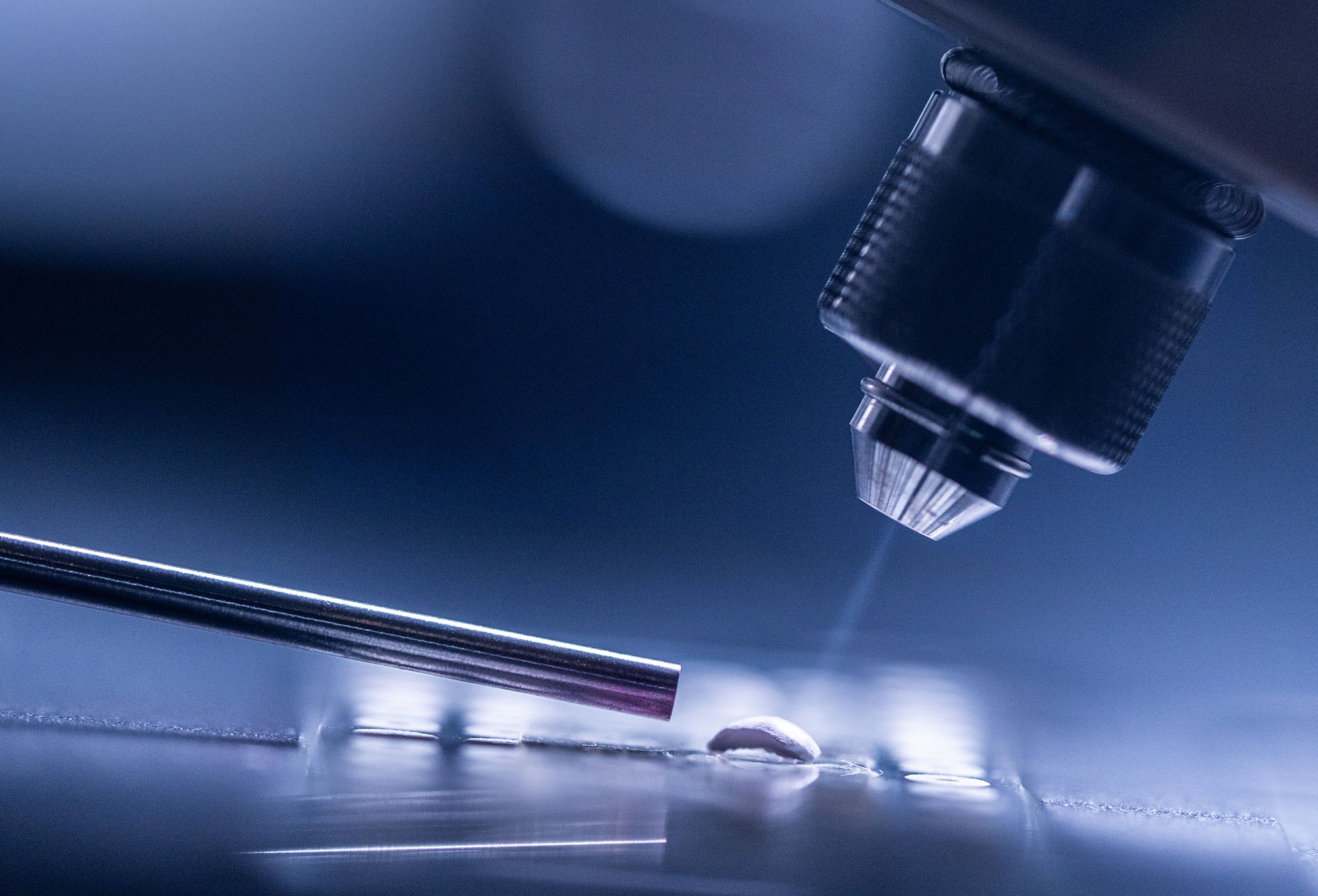
The pair stumbled onto the approach while experimenting with a mass spectrometer and a technique called desorption electrospray ionization, or DESI. The process uses electrically charged droplets sprayed at the surface of an adsorbent that ionizes only the target chemical, not the adsorbent itself.
Nathan and Ryan said the results were unexpected.
“We had toyed with the idea of using DESI to confirm the presence of PFAS on adsorbent materials,” Ryan said. “When we did some preliminary testing, not only did we confirm the presence of PFAS, but we noticed that we got results well beyond our standard analysis.”
“At this point, it became very clear we had an opportunity to push further on this work,” Nathan said. “One step at a time, we went from just being able to see PFAS at parts-per-million to levels at parts-per-billion and finally, low parts-per-trillion.”
Their technique starts with an adsorbent about the size of a Rice Krispy. The adsorbent is placed in a solution for testing. Three minutes later, it is removed and placed in front of a mass spectrometer where it is sprayed with electrically charged droplets. The droplets remove PFAS from the adsorbent and carry it into the mass spectrometer, where it is analyzed for PFAS concentration and type.
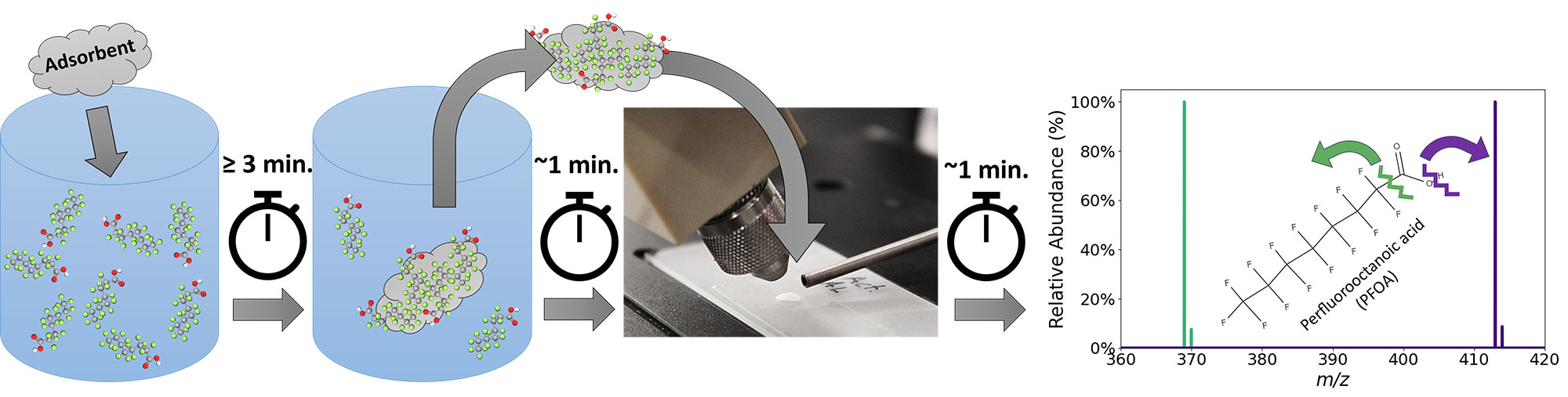
The entire process can take as little as five minutes.
“It’s one of those outcomes that wasn’t exactly planned as we had initially envisioned it,” Ryan said. “It was surprising to see the concentration of PFAS so clearly. That may be why it hadn’t been done before. It was just unexpected.”
The pair has published details of the process in hopes it can be commercialized for widespread use. They also hope it can be developed to tackle other environmental pollutants besides PFAS and used for environmental analytics and testing such as off-gassing measurements tied to Sandia’s nuclear deterrence work.
“It could help researchers understand the system’s environment and the off-gassing of chemicals in certain work,” Ryan said. “While our first phase worked with liquid, our more recent work has delved into the gas phase.”
Why they do it
Both Ryan and Nathan are passionate about this technology and PFAS remediation. Developing the new test is just a small part of the broader work they do aimed at reducing PFAS pollution.
“I’ve been working on this specific project since I joined Sandia two and a half years ago,” Nathan said. “My whole career has evolved around environmental remediation, so this was a natural fit. I’m a big outdoors person. My wife and I like to go out in nature, and we don’t like to see our world be polluted like this.”
One of the biggest focuses of PFAS remediation has been at U.S. Air Force bases, where soil and groundwater have been impacted by the long-term use of firefighting foam.
Ryan’s big goal, however, is to give people more power over their health. “More and more research shows that PFAS can have negative outcomes at even low concentrations, so detecting at those low concentrations is key,” Ryan said. “We don’t want families to worry about whether they can afford groceries this week or test their water for safety.”