


Tucked inside Sandia’s National Security Technology Gallery, hand-drawn sketches, or engineering design packages, offer a look at some of Sandia’s earliest engineering work.
In celebration of National Engineers Week, those rarely seen sketches from the Vela satellite program were briefly on display, offering Sandia a window into the past.
The Vela satellite program was initiated in 1959 — not even a decade after Sandia was established — to provide a nuclear detonation detection capability from outer space and verify compliance with nuclear treaties. Sandia initially helped develop the Vela satellites to detect gamma rays, neutrons and X-rays, the signatures of nuclear tests. Later versions added detectors for optical and electromagnetic signals as well as space-background sensors for anomaly resolution.
“We have a very decent historical evolution story about Vela,” said John Kiegel, who oversees the gallery.
Surviving artifacts like these sketchbooks help preserve that story. Originally from electrical engineer Dick Spalding, the books contain handwritten diagrams and specifications for electronic connections, schematics of circuit boards and logic diagrams. They are dated from the mid- to late-1960s.
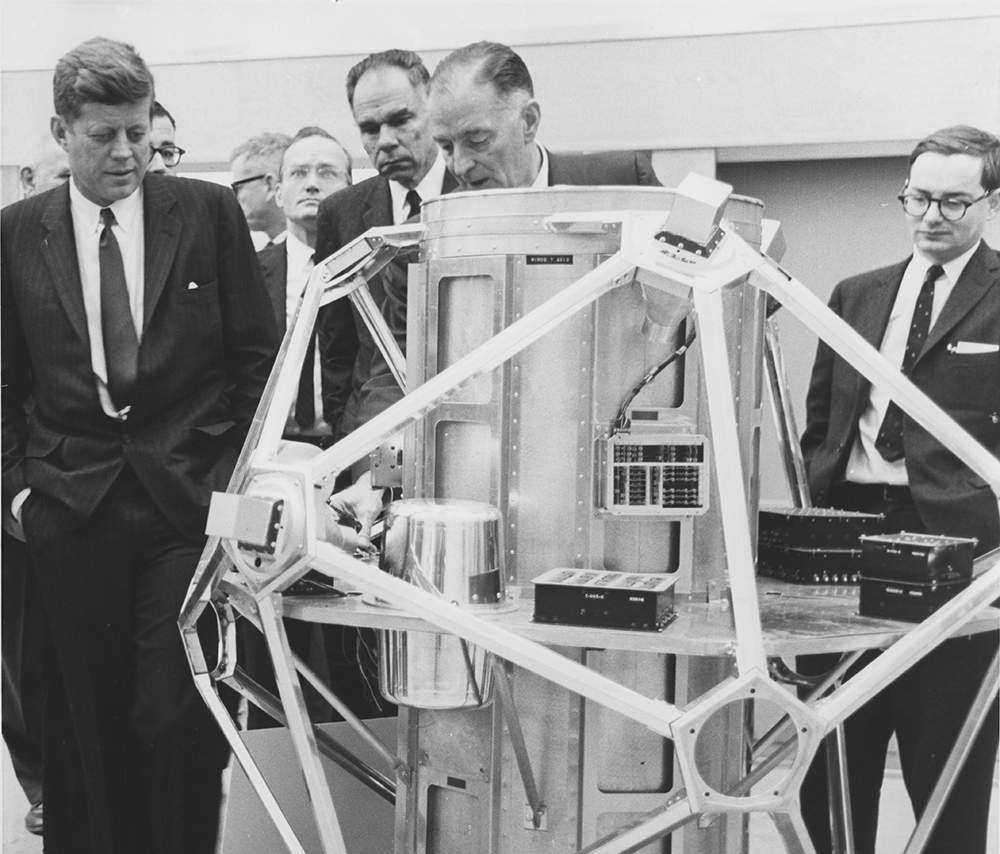
“Spalding was involved in the Vela program from its start. We can tell that satellite story in about 10 minutes with some really neat artifacts,” John said. “For anybody who works on satellites in Global Security, this is their origin story. This is how Sandia got started in space-based monitoring.”
Sandia worked closely with Los Alamos National Laboratory on the Vela program. Initially, Los Alamos developed Vela sensors and Sandia handled component integration and data processing tasks. As the program matured and decisions were made to add to the satellite’s capabilities, Sandia took on a larger role in sensor design, particularly the optical sensors.
The sketchbooks are a reminder of the important accomplishments engineers made with paper and pencil and how far engineering capabilities have come during Sandia’s more than 75 years in operation.
Growing collection

John takes any opportunity he can to build the collection at the gallery. Following Spalding’s retirement from Sandia in 2016, his office administrative assistant invited John to Spalding’s office.
“I was harvesting these artifacts relating to Vela. I got everything I could and brought it to the gallery,” John said.
The collection also includes work from Rik Holman, who John said spent his entire Sandia career working on satellites.
“Over a 30-year career, he’d collected a bunch of satellite gear. He was looking for a steward for his collection,” John said.
Holman had so many items that Sandia’s Legacy Hardware Lab took what he couldn’t fit in the gallery.
Another contributor to the Vela collection in the gallery was Dan Thompson, who retired from Creative Services.
“He had a stash of old artwork related to Vela and when he left, he gave those items to the gallery,” John said. Thompson’s father, F.E., was an engineer on the Vela program and is featured in one of the photos holding an engineering design package sketchbook.
While the last of the Vela satellites were turned off in 1984, today Sandia’s work in detection remains critical for national security. Individuals like John, with a passion for preserving Sandia’s history, remind us how far the field of engineering has come — from pencil and paper to computer-aided design to a shared digital thread, artificial intelligence and beyond.
Read more about the Vela program.