
One team uses a systems approach to find the nexus of technology and human experience

Technological advancements abound at Sandia, but one team is developing a key capability that dramatically impacts the application of new and existing technologies.
“We are at the nexus of technology and human interfaces. You cannot design a technical system in a vacuum — you have to consider how it will impact everything around it,” said Carmen Mendez, manager of Sandia’s Nuclear Energy Fuel Cycle Sociotechnical Systems group.
Carmen and her team of social scientists, engineers and program managers apply sociotechnical systems analysis and design to a diverse set of technical spaces, including the siting of nuclear waste facilities.
Identifying connections
“Sociotechnical systems design recognizes the interaction between people and technology and considers both social and technical factors that influence the functionality, practicability, acceptability and usage of a system,” Carmen said.
The team holistically analyzes five work-system elements: people, technology and tools, tasks, policies and organization, and the environment.
“Sociotechnical systems analysis looks at how technical systems integrate with social systems. We consider social processes and factors that influence how technical systems are both created and implemented,” said Lauren Drakopulos, a sociotechnical systems analyst on the team.
The purpose of evaluating the five work-system elements is to establish an understanding of how each element potentially impacts another and to better understand how a system can remain balanced. The team has applied the model to diverse applications within the nuclear energy fuel cycle and beyond.
“If I were to take a current-fleet nuclear reactor away and replace it with a hypothetical advanced reactor, what changed? Maybe the disposal of waste is different, or the maintenance schedule, the training needs for the operator, or the location and surroundings of the facility? The whole thing is rooted in a holistic perspective,” Carmen said.
“Or let’s consider the siting of a hydrogen or carbon capture facility,” Lauren said. “With a holistic sociotechnical approach, we can look at facilities with completely different purposes, but similar in nature, to understand commonalities. We can look at social and environmental qualities, like demographics, geographic conditions, community perspectives and news headlines that tell us how people are talking about the facility. We can evaluate these different dimensions to determine what factors make a siting attempt successful or unsuccessful,” Lauren said.
By understanding the factors that surround a technology, we can better understand impacts and capabilities of that technology.
Real-world applications
The diverse application space of sociotechnical systems analysis allows the team to apply the framework to various siting needs to support national security and energy production.
“We assist the DOE’s Office of Collaboration-Based Siting in developing a robust metrics program by collaborating with leadership to define and operationalize key programmatic metrics,” Lauren said. “Our efforts include evaluating existing information needs, identifying gaps and proposing new data reporting methods, ultimately collecting and reporting metrics from six national laboratories and the DOE to enhance strategic planning and data-driven decision-making.”
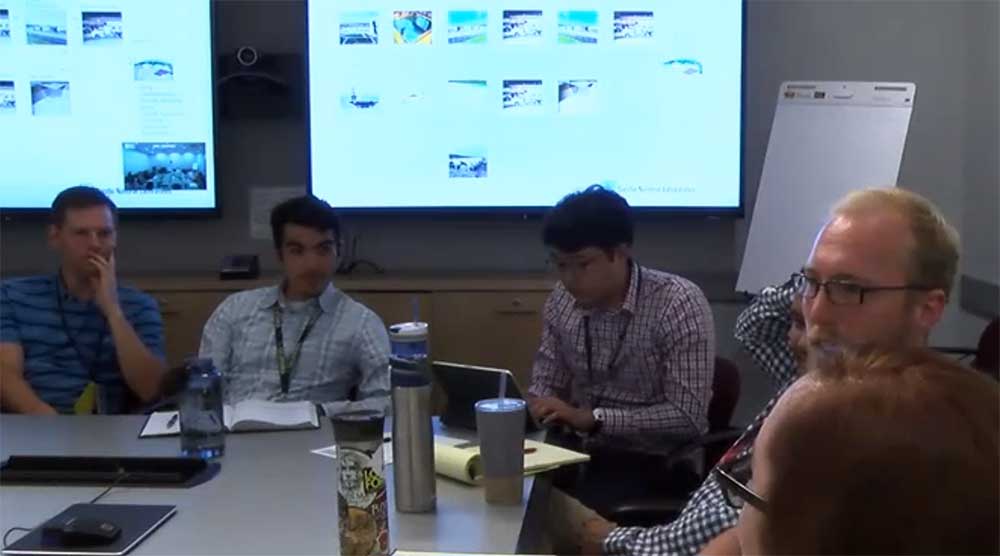
The Sandia team is also part of the Consortium Advancing Technology for Assessment of Lost Oil and Gas Wells, or CATALOG, that surveys programs that leverage technology to empower nonexperts in collecting environmental data, identifying key features that contribute to their success. The group’s scope of work includes analyzing recruitment and training strategies, uncovering technical and nontechnical barriers to technology adoption and developing actionable recommendations and best practices to enhance CATALOG efforts and ensure that their solutions effectively address stakeholder needs and challenges.
The team’s expertise also applies to the ever-growing focus on grid infrastructure and energy production.
“We are also collaborating with technology developers and grid experts to create a microgrid resilience planning tool that helps decision-makers harden microgrids against environmental hazards by identifying and prioritizing risk mitigation alternatives,” Lauren said.
Storytelling as data
“Stories create the whole picture,” said Gretchen Gano, a sociotechnical systems analyst. “Some of the most compelling evidence and information is in the form of stories and testimonies that really engage people in understanding what’s happening on the ground.”
The Sandia team focuses their efforts on collecting as much data as possible — data that corresponds directly to the five work-system elements of sociotechnical systems design. They don’t focus only on human factors, but instead view the elements as a broader social process that can be influenced by tools, tasks and organizations.
“We bring social concepts into the early design of whatever project we are doing so we have a more holistic understanding of the systems. Right now, we’re working on collaboration-based siting of nuclear waste facilities, but we are also doing work on oil and gas infrastructure, microgrid planning and other technical topics,” Carmen said.
The team combines concurrent engineering — a nonlinear, systematic approach to product and process design — and sociotechnical systems principles to create a potential roadmap for siting facility types and facilitating technology deployments. However, unlike previous models, this work is informed through community narratives, historical knowledge, technical documents, operations and business analytics, and countless data points.
“Our data could include newspaper articles, permitting documents, website materials and interviews. We triangulate data from across different sources to gain a variety of perspectives. Interviews with stakeholders provide unparalleled insights that we wouldn’t otherwise capture. For example, in collaboration-based siting, we interviewed experts that had gone through similar experiences attempting to site large-scale facilities. Even though they may have been working in different industries or sectors, they had valuable lessons to share about siting that are applicable to nuclear waste facilities,” said Lauren.
Gretchen explained that the sociotechnical systems approach accounts for community involvement, unlike other more traditional regulatory or siting processes. Oftentimes, the team is invited into the process so they can accurately capture diverse aspects of needs and demands.
“I think that’s the challenge,” Gretchen said. “Not staying in your corner but being invited into communities to discover pockets of knowledge that become a trusted synthesis of potential risks or a potential way forward.”
Capitalizing on Sandia’s systems
Sandia is known for systems engineering, so it’s no surprise that the team relies on a systems approach to capitalize on existing technical capabilities across the Labs.
“Sandia does a lot of highly advanced technological work, but because it’s so advanced in nature, sometimes the work can’t be easily deployed or may be difficult to take to market. We are focused on the deployment of the technology. Our sociotechnical team is hoping to take all of Sandia’s best strengths and make them more readily available through deployment and integration,” Carmen said.
The team inhibits siloed and compartmentalized technological processes, and instead focuses on understanding possible implications and outcomes at the inception of the process. They think about deployment, application and human factors when others are thinking of technical specifications and regulations.
“The intent of this team was to bring together a group of skills unique to Sandia and apply our rigor into a field that is typically not touched by national labs,” Carmen said.
Due to the uncommon nature of their research space in the national lab complex, the team has faced many hurdles. They’ve encountered challenging policies that academia typically does not have to work through, and, like academia, they must have a firm understanding of Internal Research Board standards and requirements. But the additional efforts are worth the unmatched understanding sociotechnical analysis creates.
“We are thinking about how to make sure that the people receiving the technologies are understanding impacts,” Gretchen said, “and part of that is using the resources we have at Sandia.”
Lauren agreed. “There are just so many opportunities at Sandia to matrix with folks who are doing great work, and it’s also what helps to contribute to that unique manifestation — because Sandia brings a systems analytical lens.”
The team uses their backgrounds and research experience to make widespread impacts in the deployment and application of critical technologies.
“Whatever the technology is, the users are the people who are going to be most directly impacted by the success or failure of that technology,” Lauren said. “So, we try to look for ties to connect with their experiences instead of thinking about them as some sort of nameless, faceless entity.”