
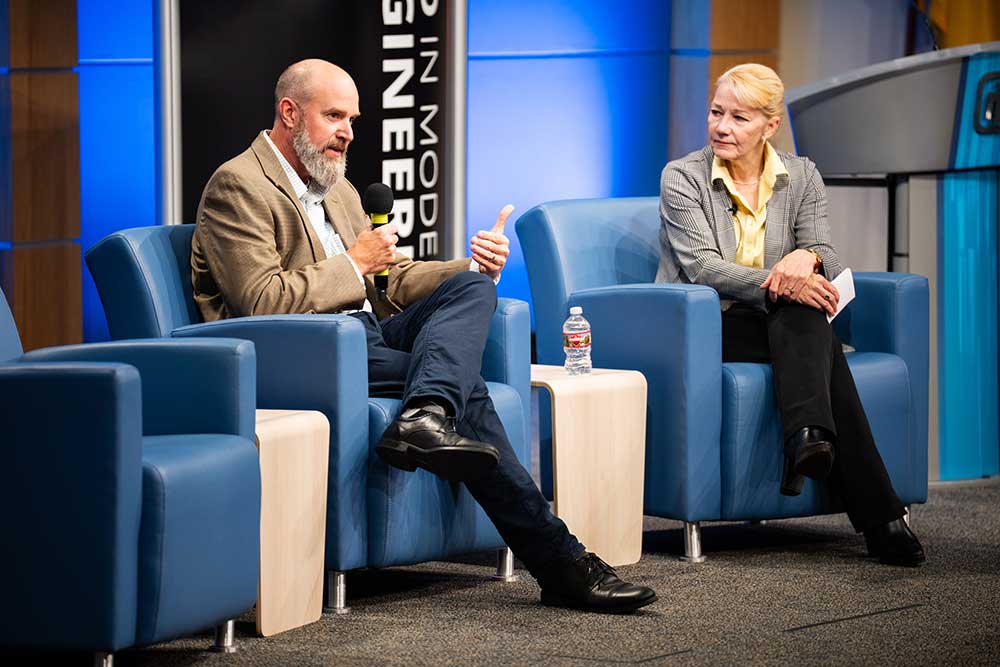
Labs Director Laura McGill and Deputy Labs Director David Gibson chatted with five staff members about making moves on Sandia’s two big goals — leading in modern engineering and accelerating innovation — during Goal the Distance on July 1.
“These goals are more important than ever. There are world events going on right now that give us every reason to be more focused on our mission — leaning into innovation, helping our national leaders understand the capabilities that we can bring to the forefront,” Laura said. “And, with the modern engineering goal, it’s important that we deliver that capability as effectively and efficiently as possible.”
Single source of truth
Laura interviewed Enabling Capabilities Senior Manager Rob Brown and Digital Engineering Transformation Senior Manager Shawn Dirk about the path to digital engineering at the Labs.
Rob spoke about using model-based systems engineering tools to develop a single source of truth. In his experience with this type of program, the tool efficiently documented and communicated information to new team members, industry partners and government partners, so that everyone was in full alignment.
Shawn echoed these benefits. “If we’re working from the same source of truth of data, we’re not making mistakes, we’re able to operate faster, we’re able to partner faster,” he said. “We are able to do our job as a systems integrator and field solutions at pace for the nation.”
Laura Jacobs, who works on the Advanced Simulation and Computing-funded Thermal Battery Design and Development team, discussed her team’s work developing a suite of tools that can be installed on any engineer’s desktop computer to review and iterate on designs quickly. She and her team are developing a tool that will incorporate data from production to improve future models.
Innovation acceleration
David presented results from recent surveys about perspectives on innovation at the Labs. Staff who reported that they can do their jobs and field solutions at pace for the nation increased from 73% to 84%. Staff who reported that their manager rewards risk-taking to drive innovation increased from 50% to 58%.
“The increase was probably a little more aggressive than I anticipated. I think it means managers are feeling comfortable setting the environment for their staff to take risk-based approaches, and staff members are starting to really buy into it,” David said.
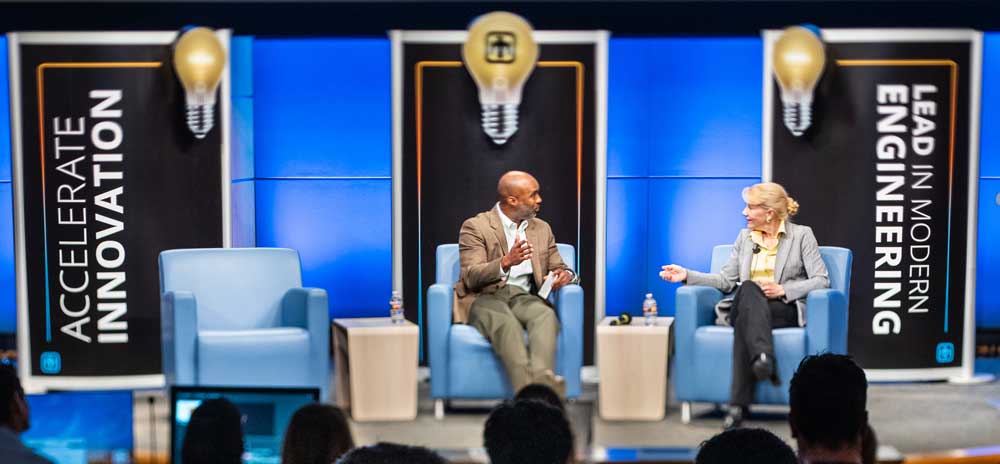
Director of Monitoring Systems and Technology Jamey Bond reflected on the Unleash Excellence tool that collects ideas from the workforce on ways to cut red tape. The top-voted idea was to improve search engines on Sandia internal websites, so this became a priority for his development team. He suggested that broadened access to metagroups could aid staff in accessing the information they need when they need it.
Microsystems Engineering, Science and Applications Director, Reno Sanchez reported that the performance of Sandia’s microelectronics meets today’s mission needs, but those needs are always evolving. Sandia needs to develop solutions that continue to work in extreme environments and offer a higher level of computational performance. MESA formed a multidisciplinary team of experts of varied levels and types of experience to generate solutions to these challenges. One solution was to develop a microelectronics device that contains “chiplets” from different semiconductor suppliers that provide both survivability and high-computational power to address future mission needs.
Reno explained this technology is “kind of like your brain stem and your brain. Your brain stem can do simple computation, but its main purpose is survivability — to regulate many essential bodily functions, including breathing, heart rate, blood pressure and sleep-wake cycles. Your brain is used when you need higher level computation power.”
Laura McGill concluded the event encouraging Sandians to exemplify the three behaviors of being purpose-driven, connected and courageous.
“This is more about a culture change than anything. About how we work together, how we think about our problems, how we lean into the opportunities presented to us,” Laura said. “One of the privileges we have at a national lab is that the nation comes to us with some of the hardest problems, and that energizes us to lean into things like innovation and embrace new ways of working to make us more effective and efficient.”
Staff can watch Goal the Distance