
Battery energy storage systems (BESS) increasingly combine power electronics, sensors, communications technology, and controls directly within the system’s battery modules. Under these conditions publicly available battery cycling data, information about the battery’s performance and health when repeatedly charged and discharged, remains limited. To help address this, Armando Y. Montoya and a team of researchers at Sandia National Laboratories developed a flexible battery energy storage system that can be used to operate any type of modular electrochemical system to generate and collect real-world cycling data.
The system utilizes mixed battery chemistries with modular power electronics, sensors, serial communications, and controls across four parallel-connected battery modules. Sandia’s work provides a flexible and validated platform that can integrate and cycle battery modules with a varying range of characteristics under realistic, system-level operating conditions. This chemistry-agnostic capability also allows emerging battery technologies to be evaluated within a common test environment while generating data that aids researchers in understanding how power electronics-interfaced operation affects battery performance, thermal behavior, electrical response, and long-term operation.
Since the system’s development, the team has added new control algorithms and software integration capabilities that enable users to control individual modules. This improves the system’s flexibility for controlled cycling and diagnostics which allows for the testing of any battery chemistry. The team also upgraded the system’s data acquisition pipeline to include live measurement visualization through a real-time dashboard and cloud-based data storage. The added features strengthen the platform’s ability to validate emerging chemistries, battery integration technologies, and computational models; they also offer real-time monitoring and support future research on battery energy storage system operations.
The system provides a ready-to-use and chemistry-agnostic platform to integrate batteries with the electric grid and supplies much-needed data about how batteries behave in integrated, power-electronics-interfaced systems. Making this data available helps create more accurate battery models and improve AI training datasets, among other applications.
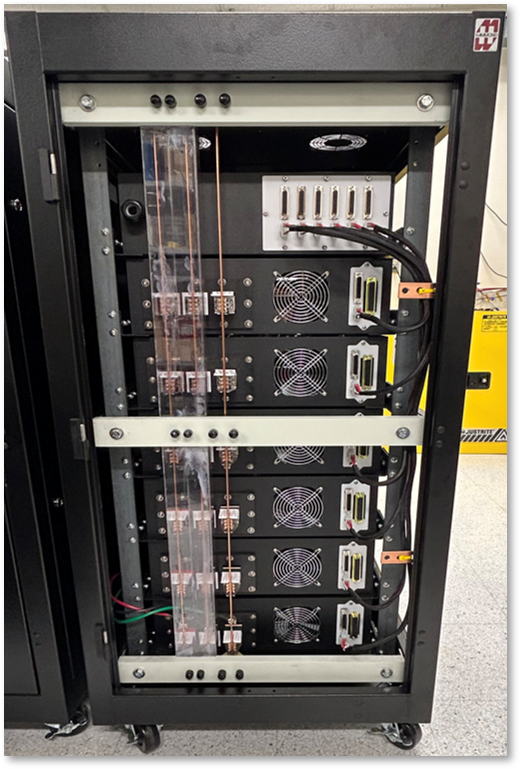
A flexible, or hybrid, battery energy storage system (HBESS) using mixed battery chemistries with modular power electronics, sensors, communications technology, and controls across four parallel-connected battery modules. The system was developed at Sandia National Laboratories and provides a platform to conduct experiments and research on these increasingly common hybrid systems.
Credit: Armando Montoya, Sandia National Laboratories
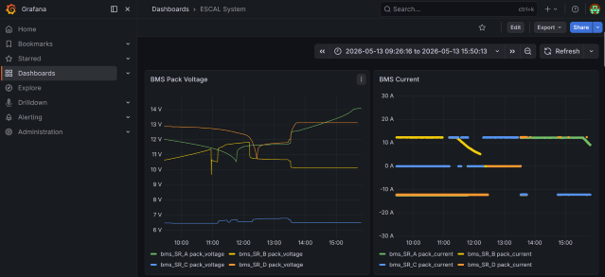


A screenshot from the visual dashboard that accompanies the system.
Credit: Armando Montoya, Sandia National Laboratories
This material is based upon work supported by the U.S. Department of Energy, Office of Electricity (OE), Energy Storage Division.