Tunnel Vision
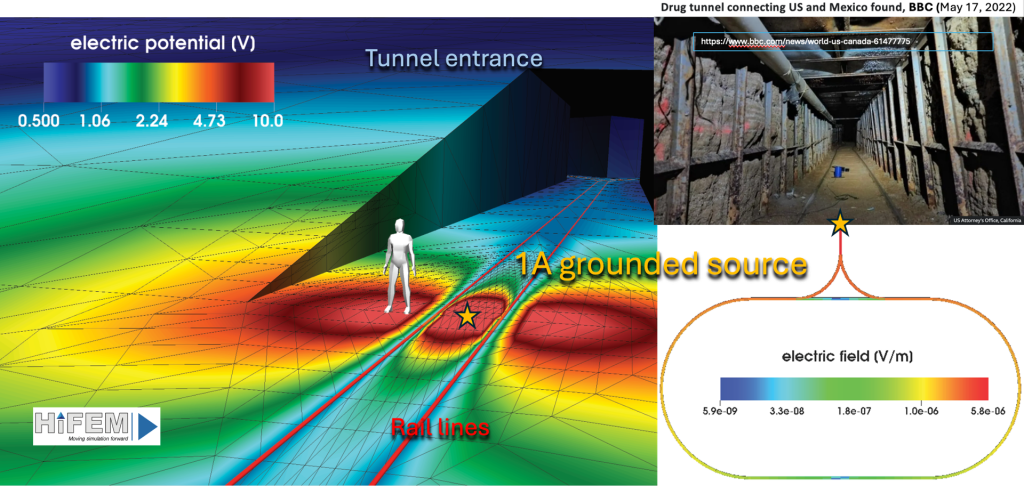
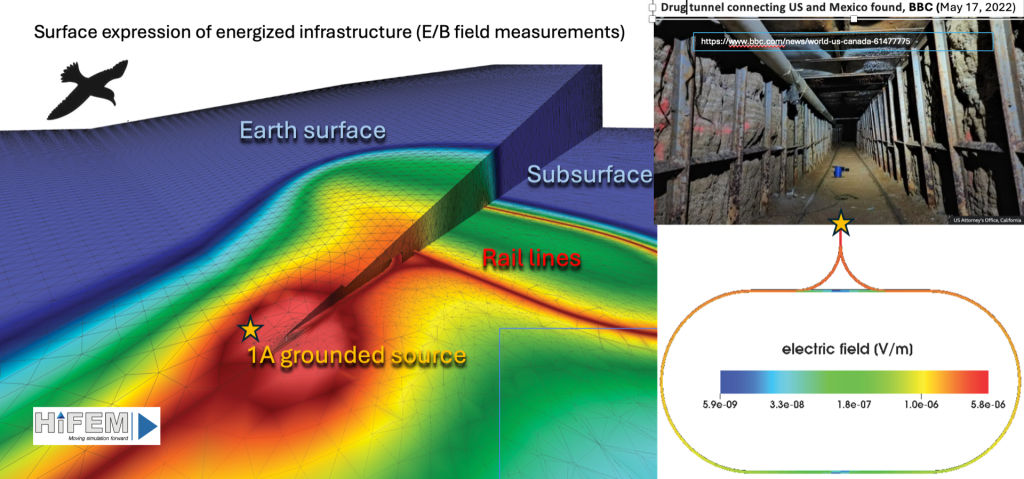
The location of tunnels for both humanitarian and border security objectives remains an ongoing challenge for geophysical data analysis. Exploiting the presence of metallic artifacts in the tunnel is one method by which this challenge can be met and HiFEM’s edge-based material representation is uniquely suited to the task. Either through direct electrification or inductive coupling this infrastructure (e.g., rail lines) generates its own electromagnetic signature that permeates the subsurface and the ground above. Quantification of this signature with HiFEM’s electrostatic and “full Maxwell” capabilities provides the geophysical analyst with a practical solution for understanding hidden, complex tunnel geometries.
Oilfield Characterization
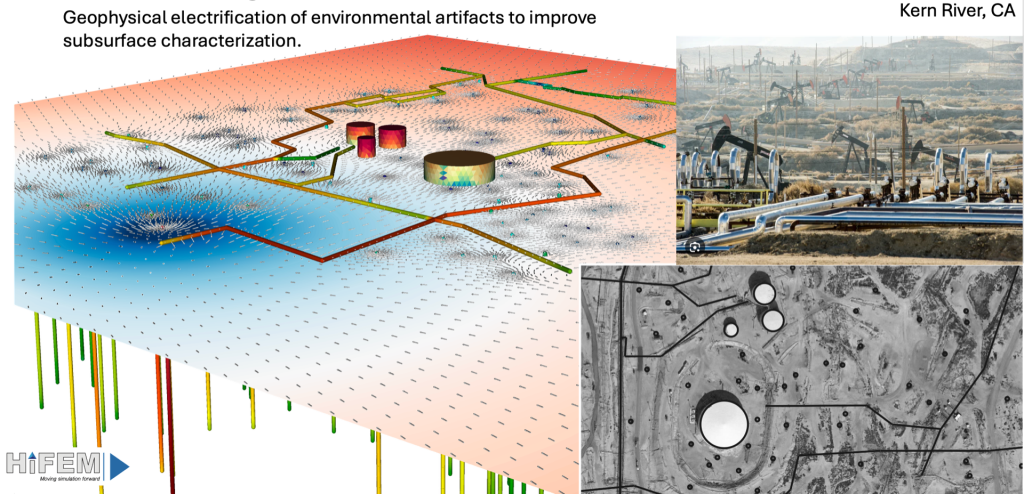
Subsurface imaging in areas rich with metallic infrastructure is computationally explosive because of the high resource cost of full volumetric discretization. Millions of tetrahedra are required to discretize a single kilometer of steel pipe; oilfields typically contain 10s to 100s of kilometers of pipe both in the subsurface and on the ground. The combination of unstructured tetrahedral meshes and HiFEM’s representation of steel pipe by edge-based material properties enables realistic simulation of as-built oilfield systems on inexpensive desktop and laptop computers. Such simulations provide powerful insight to how the infrastructure can both distort geophysical signals or be used to enhance them for gains in reservoir management, placement of new wells, and our understanding of the movement/location of subsurface fluids.
Fracture Mapping
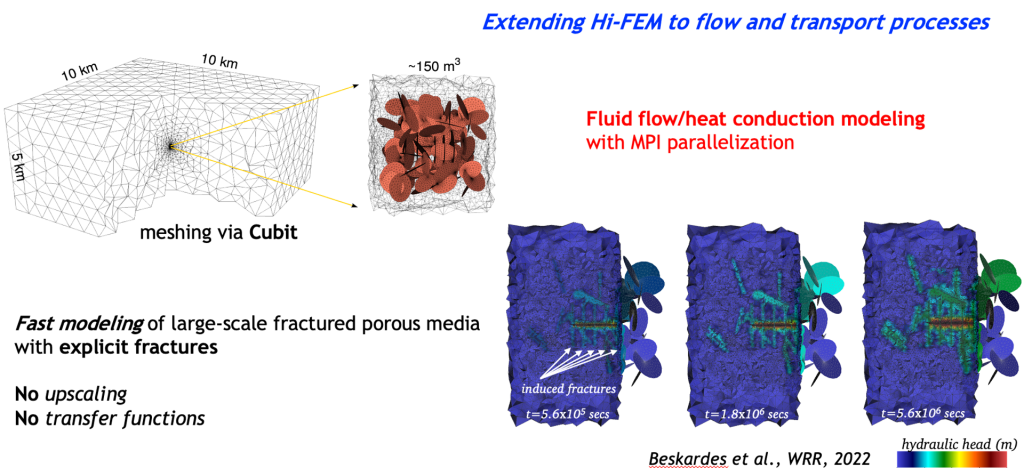
HiFEM’s face-based representation of material properties can be used for quantification of fully- and naturally-coupled flow problems in fractured media. Without reliance on ad-hoc coupling schemes between the fractures and surrounding matrix, the physics of HiFEM’s Darcy and heat flow formulation allows the coupling to unfold naturally as the natural variations in fracture geometry and matrix heterogeneity dictate.
Orphaned and Abandoned Wells
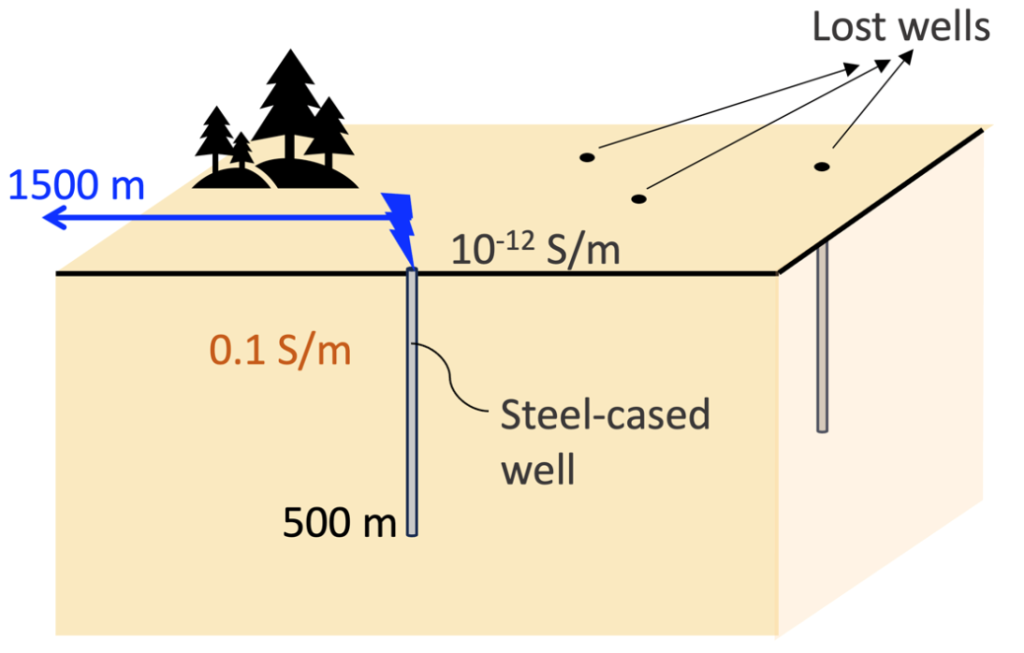
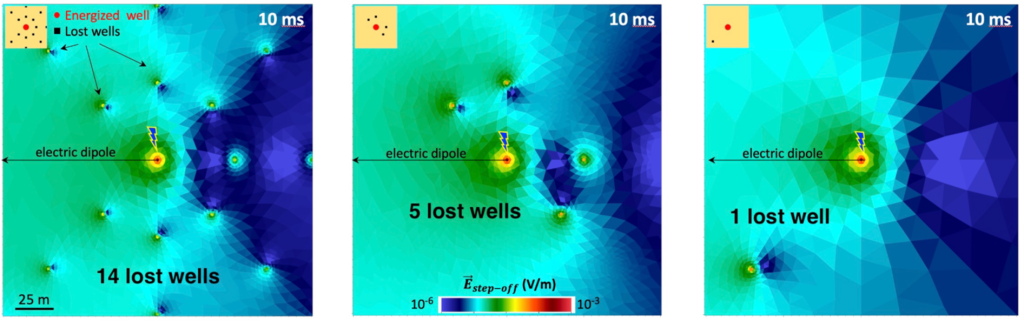
Generally, orphaned wells are defined as idle wells for which the operator is unknown or insolvent. It is estimated that there are hundreds of thousands of undocumented orphaned wells in the United States with unknown locations and missing information, such as ownership or construction details. Since many of these wells retain their steel casing from when they were operable, they are excellent targets for electromagnetic (EM) excitation. HiFEM is a computationally efficient modeling framework to compute their EM response, whether at DC, in the frequency domain, or in the time domain. This capability supports DOE’s mission to advance energy addition, unleash energy innovation, and streamline permitting. Here, we demonstrate how a known well can be used as an antenna of opportunity to illuminate the presence of neighboring lost, abandoned wells.