
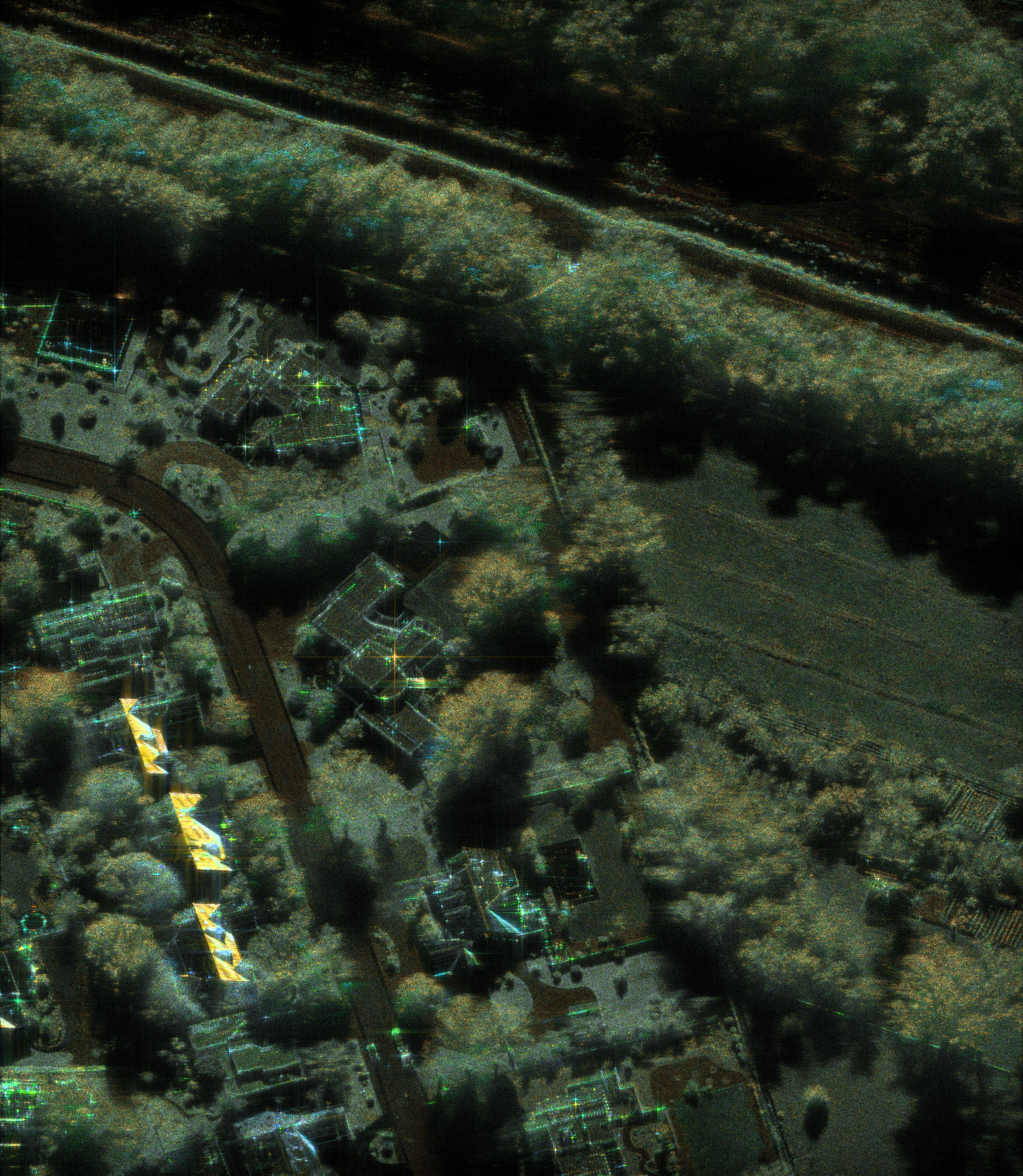
At Sandia National Laboratories, we are at the forefront of developing and integrating advanced radar technologies that seamlessly operate across diverse platforms and environments.
Our deep understanding of radar principles, signal processing, and system architectures enables us to create highly interoperable solutions that meet the most demanding national security challenges. Sandia’s radar sensor systems leverage developments in small, low-power, embedded processors, along with custom electronics miniaturization, extreme system integration, and intelligent application of commercial off-the-shelf (COTS) interfaces and form factors. The key to the next generation of small, compact sensor design is the co-location and integration of radar functionality, which allows employment on a multitude of manned platforms and Unmanned Aerial Vehicles (UAVs).
Sandia capitalizes on multi-mode sensors with onboard real-time processing to enable advanced functionality and adaptability to meet dynamic situational requirements. Additionally, Sandia’s Human Analytics research and development laboratory ensures that interfaces and workflows maximize the usability of its systems for high-consequence analysis and decision-making applications.
Foundational Expertise in Radar Architectures and Signal Processing
Sandia’s proficiency in radar systems is built upon a strong foundation in understanding various radar architectures and their optimal implementation. For instance, our research on monopulse antennas demonstrates a comprehensive grasp of how different antenna technologies—such as dish reflectors or flat panel arrays—can be adapted for either amplitude-comparison or phase-comparison monopulse techniques. This adaptability underscores our ability to integrate diverse hardware components and optimize their performance for specific applications. Our studies confirm that while implementation details may vary, the fundamental precision of Direction of Arrival (DOA) estimation primarily depends on antenna size, operating wavelength, and Signal-to-Noise Ratio (SNR), showcasing our focus on core performance metrics regardless of the underlying architecture.
Advanced Waveform Design and Processing for Seamless Operation
A critical aspect of interoperability is the ability of radar systems to adapt to and process various signal types effectively. Sandia’s work on Linear FM Chirp for Radar highlights our expertise in designing and processing robust radar waveforms that are essential for high-performance systems. The Linear FM chirp, often considered the “gold standard” of radar waveforms, is widely adopted due to its ease of generation and processing across various techniques. Our researchers have extensively detailed how these waveforms can be generated using diverse technologies, from dispersive networks and voltage-controlled oscillators to advanced Digital Waveform Synthesis (DWS).
Furthermore, our deep understanding of stretch processing is a testament to our integration capabilities. This technique allows for the efficient digitization and processing of wide-band Linear FM chirp signals, enabling radar systems to operate with significantly reduced bandwidth requirements for analog-to-digital conversion. This is crucial for integrating fine-resolution radar capabilities onto platforms with limited processing resources. Our detailed analysis includes:
- Matched Filter and Correlation Processing: Optimizing Signal-to-Noise Ratio (SNR) in the presence of noise and efficiently processing received signals through matched filters and correlators.
- Intra-Pulse Doppler Compensation: Addressing and mitigating the effects of target or radar motion on signal quality, ensuring accurate measurements even in dynamic environments.
- Sidelobe Control: Implementing advanced filtering techniques to reduce undesirable sidelobes in processed radar returns, improving target detection and recognition.
- Deskewing: Developing sophisticated digital signal processing (DSP) operations to correct for signal dispersion, enhancing image quality and maximizing SNR across all ranges.
Integrating Artificial Intelligence for Adaptive and Cognitive Radar Systems
Sandia is actively exploring the integration of Artificial Intelligence (AI) and Machine Learning (ML) to create more adaptive, autonomous, and interoperable radar systems. This includes leveraging AI for:
- Waveform Optimization: Utilizing reinforcement learning and genetic algorithms to optimize radar waveforms in real-time, allowing systems to adapt to changing environmental conditions, avoid interference with communication systems, and enhance performance metrics. This capability is vital for cognitive radar, where systems can make intelligent decisions about their operations.
- Antenna Design: Applying genetic algorithms and deep neural networks to optimize antenna parameters and array designs, leading to high-performance and unconventional antenna structures that meet complex requirements. This ensures that radar hardware is optimized for integration into various platforms and operational scenarios.
Real-World Applications and Impact
Our expertise in interoperability and integration is demonstrated through successful deployments and advanced research initiatives. For example, the Lynx (AN/APY-8) SAR system, with original prototypes designed by Sandia for General Atomics, showcases our ability to deliver high-performance radar capabilities in a compact package that has flown on a variety of manned and unmanned aircraft, including helicopters. Via a continuing Cooperative Research and Development Agreement (CRADA) partnership, Sandia has supported and facilitated developing enhanced capabilities that showcase this system’s flexibility and real-time ISR modes, thereby exemplifying our commitment to developing radar solutions that are not only powerful but also adaptable to diverse operational needs.
Learn More About the Lynx SAR System
Through continuous innovation in radar architecture, signal processing, and the strategic integration of AI, Sandia ensures that our radar systems are at the forefront of interoperability and integration, providing unparalleled capabilities for national security and beyond.