
Do you want the full story in granular detail? We’ve put together a detailed report on the basis and logic behind identification of risks and mitigations
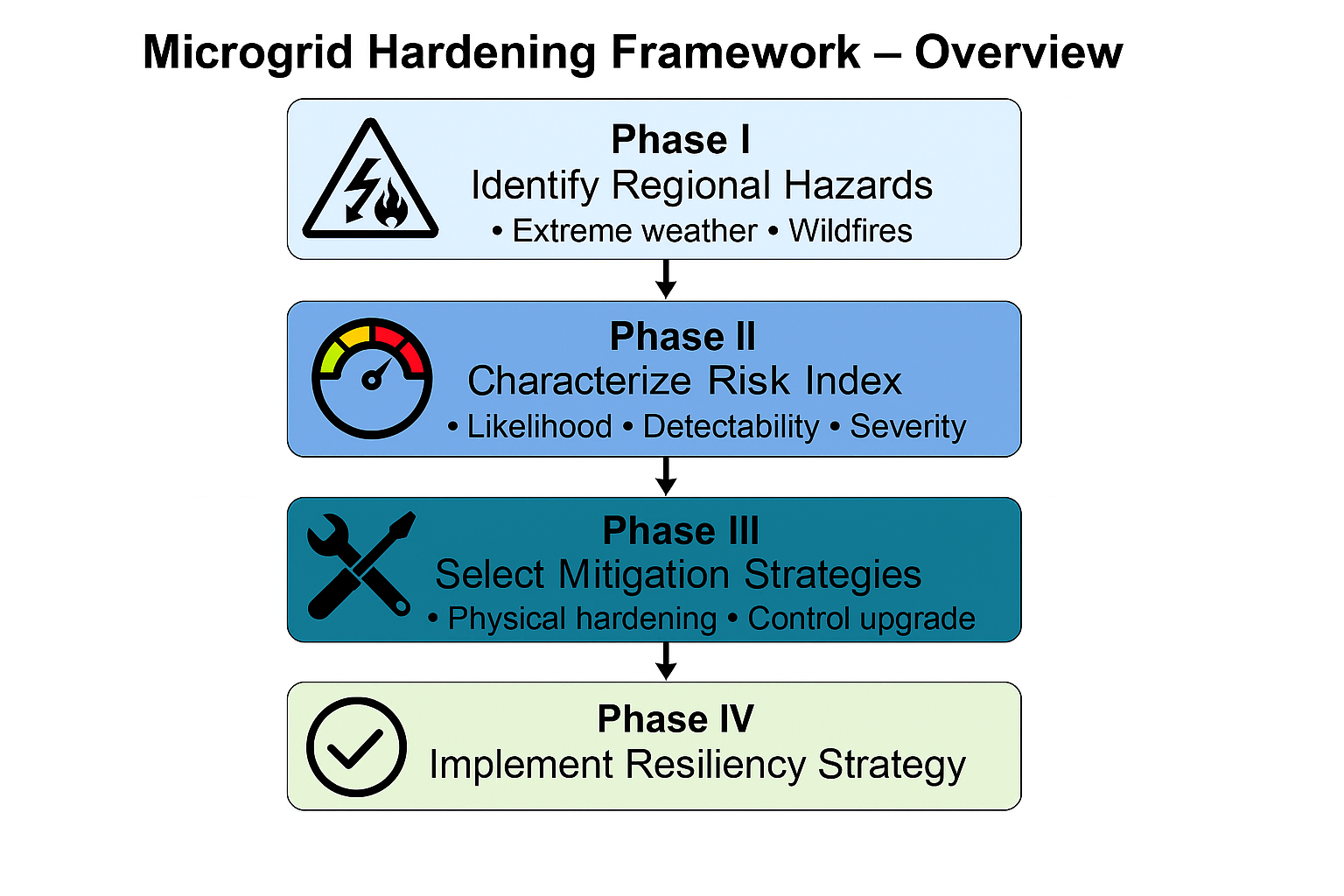
Extreme weather events and natural disasters pose significant risks to electrical infrastructure, including microgrids, which are increasingly deployed to enhance energy resilience. This report characterizes the vulnerabilities of microgrid components—such as energy generation assets, energy storage systems, load assets, power delivery hardware, and sensing/control systems—under harsh environmental conditions. It introduces a Microgrid Hardening Decision Framework, a four-phase methodology for identifying regional hazards, quantifying risk through a qualitative Risk Index (based on likelihood, detectability, and severity), and prioritizing mitigation strategies using a cost-effectiveness metric. The report provides detailed analyses of failure modes for key technologies (solar PV, wind turbines, combined heat and power systems, and battery energy storage) and outlines hardening techniques, including structural reinforcements, environmental protections, and advanced control architectures. Additionally, it discusses place-based risk examples and applies the framework to a Puerto Rico case study, demonstrating its adaptability for disaster-prone regions. Findings underscore the importance of integrated physical, operational, and communication strategies to ensure microgrid resilience against cascading failures triggered by natural hazards.