Search

Results 326–350 of 402

Sandia-led Earth System Modeling Project Featured in ECP Podcast

News Article, July 1, 2020 • CCR researcher Mark Taylor was interviewed in a recent episode of the “Let’s Talk Exascale” podcast from the Department of Energy’s Exascale Computing Project (ECP). Taylor leads the Energy Exascale Earth System Model – Multiscale Modeling Framework (E3SM-MMF) subproject, which is working to improve the ability to simulate the water...


Sandia-led Supercontainers Project Featured in ECP Podcast

News Article, April 1, 2020 • As the US Department of Energy’s (DOE) Exascale Computing Project (ECP) has evolved since its inception in 2016, what’s known as containers technology and how it fits into the wider scheme of exascale computing and high-performance computing (HPC) has been an area of ongoing interest in its own right within...

Sandia, PNNL, and Georgia Tech Partner on New AI Co-Design Center

News Article, October 1, 2019 • Sandia National Laboratories, Pacific Northwest National Laboratory, and the Georgia Institute of Technology are launching a research center that combines hardware design and software development to improve artificial intelligence technologies. The Department of Energy Office of Advanced Scientific Computing Research (ASCR) will provide $5.5 million over three years for the research effort,...
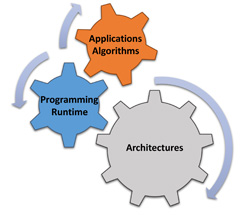
The Artificial Intelligence-focused Architectures and Algorithms concept has applications, algorithms, programming runtime and architectures all working together

SBIR Award Panel

Award, February 8, 2011 • Review board, Department of Energy, ASCR.

SBIR/STTR Programs Review Panel

Award, December 13, 2017 – January 23, 2018 • Society/professional leadership, The Office of Advanced scientific computing in the Office of Science at the US Department of Energy.

Scalable Algorithms

Focus Area • Effective use of extreme-scale computing systems depends on the availability of scalable parallel algorithms. Sandia has a long history of activities in this area, with a focus on algorithms to enable parallel science and engineering simulations. Core areas of competency include dynamic load balancing for adaptive applications, iterative linear solvers,...

Scalable Algorithms

Department • The Scalable Algorithms Department develops new algorithms and approaches to address challenges in next-generation computing hardware. The department uses its expertise in applied mathematics and computational science to address these challenges and help define the future of computing.  We have four main research thrusts:  performance portability, scalable solvers, scalable graph...

Scalable Computer Architecture

Department • The Scalable Computer Architectures department supports the development of future supercomputer systems for leading edge high performance scientific and data analytic applications. Areas of active research include: HPC system architectures, System-on-Chip processor designs, advanced memory subsystems, interconnection networks, large-scale system resilience, power monitoring and control, application performance analysis, the development...

Scalable Computing

Research Area • The CCR has a legacy of leadership in high-performance computing (HPC) at extreme scales. First-of-a-kind platforms, such as the Intel Paragon, ASCI Red (the world's first teraflops computer), and Red Storm (co-developed by Cray), helped form the basis for one of the most successful supercomputer product lines ever—the Cray XT...

Scalable System Software

Department • The Scalable System Software Department in the Center for Computing Research at Sandia National Laboratories explores and creates infrastructure that will shape the future of extreme-scale scientific computing systems. Driven by more complex workloads and the recent emergence of artificial intelligence and machine learning techniques, future high-performance computing (HPC) systems...

Scientific Machine Learning

Department • The mission of the Scientific Machine Learning Department at Sandia National Laboratories is to lead research, development, and application of artificial intelligence and machine learning to scientific and engineering problems.  The department is well known for research contributions in inverse modeling, design optimization, parameter estimation, uncertainty quantification and verification, and...

Scott A. Mitchell

Staff Page • Computational Mathematics. For more detailed information about me, see my home page, sandia.gov/~samitch

Scott Larson Nicoll Levy

Staff Page • Scalable System Software. Biography I am a Senior Member of Technical Staff in the Scalable System Software department of the Center for Computing Research (CCR). I research system software for next-generation extreme-scale systems. Specifically, I study the impact of system failures, and other sources of performance interference, on the execution...

Secure multiparty computation supports machine learning in sensor networks.

News Article, January 1, 2022 • The Cicada project is a collaboration between Sandia National Laboratories and the University of New Mexico to develop the necessary foundations for privacy-preserving machine learning in large networks of autonomous drones.  Their approach utilizes secure multiparty communication methods to protect information within decentralized networks of low-power sensors that communicate via...
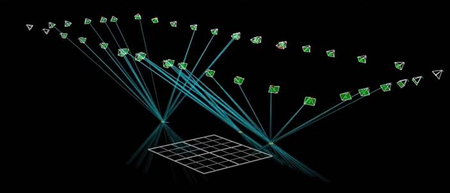
Illustration of privacy-preserving communication over a network of autonomous drones.

Senior Member

Award, May 7, 2009 • Internal - employee recognition award, ACM.

Senior Member

Award, September 4, 2012 • Internal - employee recognition award, IEEE. Senior Member is the highest professional grade of the IEEE for which a member may apply. It requires experience, and reflects professional accomplishment and...

Senior Member

Award, March 1, 2014 • Other external recognition, Association for Computing Machinery.

Session Organizer

Award, August 12, 2013 – October 9, 2013 • Society/professional leadership, INFORMS Annual Meeting.

Simon Garcia de Gonzalo

Staff Page • Scalable Computer Architecture. Biography Dr. Simon Garcia de Gonzalo is a senior member of technical staff in scalable computer architectures and exascale technologies. Simon currently is part of different projects/teams such as: Vanguard Advanced Architecture Prototype program and the Application Performance Team. Before joining Sandia National Laboratories in 2022 he...

Siva Rajamanickam Recognized as an “HPC-AI Vanguard” by insideHPC

News Article, August 19, 2025 • CCR researcher Siva Rajamanickam has been recognized by insideHPC as one of the “Vanguards of HPC-AI,” which spotlights emerging thought leaders and innovators in HPC- AI and scientific computing. Siva was selected “for demonstrating qualities of exemplary team leadership.” Read the insideHPC article here: https://insidehpc.com/2024/12/vanguards-of-hpc-ai-sandias-siva-rajamanickam-ai-for-science-outpaces-predictions/

Slycat

Software • Slycat™ is a web-based system for analysis of large, high-dimensional data, developed to provide a collaborative platform for remote analysis of data ensembles. An ensemble is a collection of data sets, typically produced through a series of related simulation runs. More generally, an ensemble is a set of samples, each consisting of...

Slycat Enables Synchronized 3D Comparison of Surface Mesh Ensembles

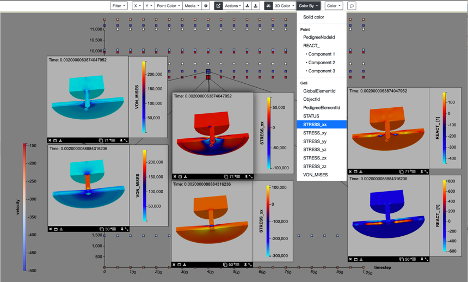
News Article, December 1, 2020 • In support of analyst requests for Mobile Guardian Transport studies, researchers at Sandia National Laboratories have expanded data types for the Slycat ensemble-analysis and visualization tool to include 3D surface meshes.  Analysts can now compare sets of surface meshes using synchronized 3D viewers, in which changing the viewpoint in one...
Here we see 3 cloned viewers for each of 2 runs at timestep 400 (red and blue selected points). The clones are vertically matched between the 2 runs to display the same 3 variables: the cell-based variables of Von Mises and stress along the X-axis, and the first component of the point variable React. The top row is an example of a simulation using the fastest initial velocity value (blue scatterplot point), while the bottom row is an example of the slowest (red scatterplot point).

Smart Grid

Focus Area • Electricity grid operators routinely solve optimization problems to address core decision processes at various time-scales, ranging from 5 minutes to multiple decades. Historically, these problems are addressed in terms of deterministic optimization, with resources kept in reserve to address any potential uncertainty regarding the future. In the context of daily...
Results 326–350 of 402