

QuESt PCM is an open-source power system production cost modeling tool designed for high-fidelity representation of energy storage systems (ESS). Built in Python, it uses the Pyomo optimization interface to formulate technology-specific storage models and to capture diverse storage operational constraints. The tool also models market participation capabilities of storage systems, helping assess their impacts on day-ahead and real-time price signals. Python wrappers allow seamless simulation of market operations, and EGRET serves as the optimization engine for security-constrained unit commitment and economic dispatch. QuESt PCM is available for install through QuESt 2.0: Open-source platform for Energy Storage Analytics.
Below is a high-level overview of the QuESt PCM tool.
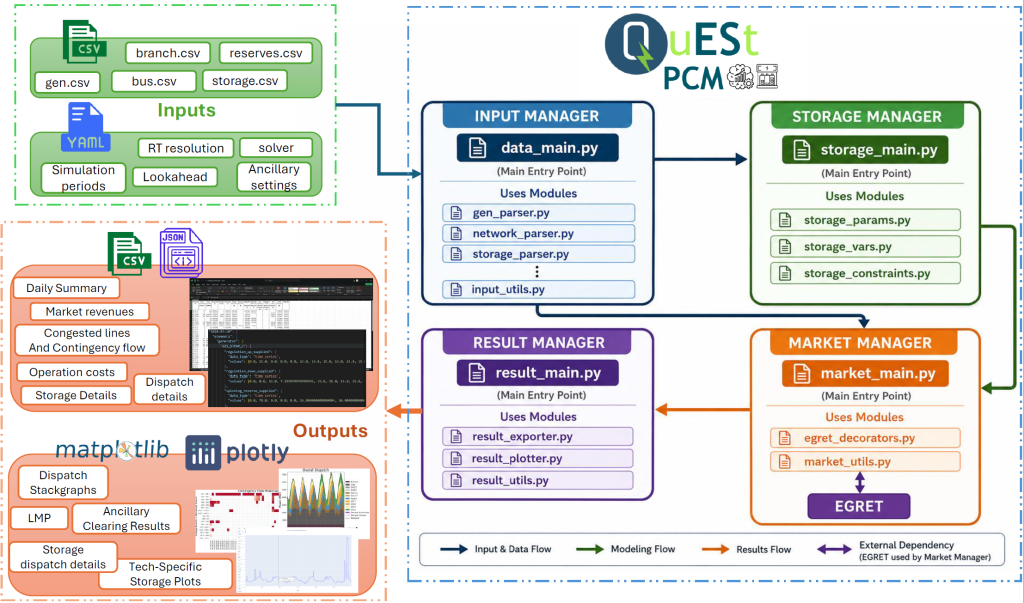


Key Features:
- Cost-Optimal Dispatch and Commitment: Coordinates day-ahead and real-time simulations to determine least-cost generation dispatch while respecting technical and reliability constraints. The tool ensures proper initialization and coupling of intertemporal variables, maintaining consistency between day-ahead and real-time operations. Optimization problems are solved using EGRET, enabling accurate modeling of multi-period dispatch and commitment decisions.
- High-Fidelity Energy Storage Modeling: Accurately represents a broad range of energy storage technologies, capturing technology-specific operational constraints, charge/discharge behavior, efficiency characteristics, and degradation effects. Examples include cycling and aging characteristics of battery storage, as well as generator and pump dynamics of pumped hydro storage. The tool also evaluates the impact of storage operation on system flexibility, reliability, and cost.
- Market Participation Simulation: Models storage participation in both day-ahead and real-time markets to assess revenue potential and influence on market price signals. The tool addresses key challenges in integrating storage systems into production cost models, including ancillary service state-of-charge constraints, and incorporates rolling-horizon coordination to align day-ahead and real-time storage schedules.
- Flexible Scenario Analysis: Enables exploration of multiple operational and market scenarios to evaluate sensitivities under varying conditions. Users can configure real-time market clearing frequencies, lookahead horizons, and flexible allocation of ancillary services, including regulation, spinning, non-spinning, and supplemental reserves. Storage participation levels in these services can also be customized.
- Open-Source and Extensible: Built in Python with transparent, modifiable code for research, teaching, and practical power system studies.