
On March 26, Sandia researcher Oindrilla Dutta presented at an industry session at the 41st IEEE Applied Power Electronics Conference and Exposition (APEC). The presentation focused on grid-forming battery systems. These systems can provide significant benefits to the grid by mitigating transients, enabling black start, offering fault ride through, and supplying uninterrupted power to critical loads and support highly variable load profiles such as data centers. In addition to diversifying energy availability and reliability, these features can improve investment returns for grid-scale battery energy storage system (BESS) installations. However, there are currently very few operational grid-forming batteries worldwide.
Existing fleets of grid-following BESS can be converted to grid-forming systems. Some utilities and system integrators achieve this by retrofitting commercially available grid-forming inverters. These inverters are well designed to meet the standards on the AC-side where they connect to the grid. However, standards do not exist for the DC-side, where batteries interface. Considerable issues must be addressed at the DC side, such as the type of connection (non-modular or modular), stability of point-of-common-coupling, ‘hot-swap’ capabilities, hybrid chemistries, and disparate state of health of cells, among other considerations.
Titled “Grid-Forming Batteries,” the talk shared the advantages of grid-forming batteries, their control challenges and mitigation techniques, and Sandia’s efforts in improving their scalability and reliability. APEC is one of the largest technical conferences in North America, with more than 5,000 participants from over 50 countries each year. Presentations such as Dutta’s industry session help bridge research and practice to heighten power electronics’ real-world impact.
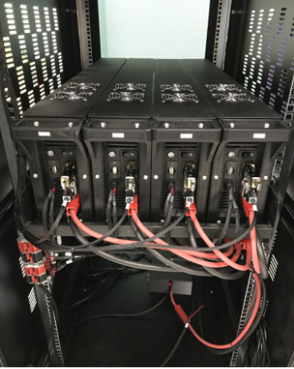
Photo: A modular battery energy storage system within an electrical cabinet. Federally funded research into grid-forming inverters’ DC-interface is helping to unlock and accelerate the devices’ benefits for utilities and consumers.
This material is based upon work supported by the U.S. Department of Energy, Office of Electricity (OE), Energy Storage Division.