
Rechargeable alkaline zinc batteries could supply safer and lower-cost energy storage for large-scale, stationary battery installations compared to similar alternatives. However, their commercial development and use for grid-scale energy storage is still in its infancy, in part due to the poor reversibility of zinc anodes in alkaline electrolytes. This means that over time and use, the batteries cannot reverse their internal chemical reactions, preventing their ability to be recharged and reused. Energy loss in the battery is partly due to active ’zinc’ material dissolution away from the zinc electrode where it is no longer effectively used. A strategy has been developed which not only minimizes the active material dissolution but recaptures it — in essence preserving and restoring material that can recontribute to the battery’s delivered energy.
Funded by the Office of Electricity Energy Storage Division, researchers at Georgia Institute of Technology and Sandia National Laboratories demonstrated a viable, scalable mechanism to preserve and restore the battery’s zincate ions. Results published earlier this year show that, instead of an irreversible loss, the mechanism successfully recovers the ions — and battery lifetime.
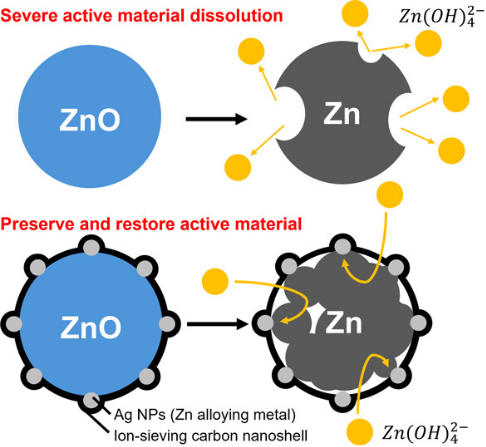
Prior research has successfully increased researchers’ understanding and effectiveness in mitigating the issue. But earlier designs relied on passively confining the battery’s zincate ions using a carbon shell. Over time and use, the ions leak through these barriers and “escape” into the surrounding electrolyte, gradually reducing the battery’s ability to store and deliver energy. The mechanism and design tested by Georgia and Sandia instead preserves and restores the ions, enabling the battery to perform. In addition, researchers developed a more scalable method for producing the design, simplifying mass production and enabling further scaled-up production.
While still in the early stages, the research points to a practical path to make this earth-abundant battery type and unlock its benefits for consumers and the national grid.
Citation: Z. Chen et al., “Restoring escaped zincate in rechargeable alkaline zinc batteries with a seed-in nanoshell design,” accepted for publication in ACS Energy Letters, manuscript ID nz-2026-00301p.R1, 15 Apr. 2026. [Online]. Available: https://pubs.acs.org/doi/10.1021/acsenergylett.6c00301. (Sandia collaboration with Georgia Tech)