
Sandia researchers contributed to a new publication that describes 10x faster physics-based battery models. Accurate battery models are essential for safe control and extended lifetime of batteries in applications ranging from consumer electronics to grid energy storage. Physics-based battery models offer significantly higher accuracy in predicting battery performance, but they are typically too computationally demanding to implement in a battery management system (BMS). In this work, researchers demonstrated a method to mathematically reformulate a physics-based model to reduce the computational time by 10x. Implementing physics-based models in a BMS is especially critical for load support for data centers, which can experience conditions such as fast and dynamic current fluctuations. The empirical models traditionally deployed in BMSs do not perform as well in such ‘non-nominal’ conditions. This work was led by UT-Austin, with input from Sandia, Medtronic, and GM and several of the companies are already using these models in their workflow.
Jindal, P., Mishra, L., Thiagarajan, R. S., Gomadam, P. M., Garrick, T. R., Preger, Y., De Angelis, V., Subramanian, V. R. “Efficient Reformulation of Linear and Nonlinear Solid-Phase Diffusion in Lithium-ion Battery Models Using Symmetric Polynomials – II. Dimensional Form for Spherical, Cylindrical, and Rectangular Coordinates,” Journal of the Electrochemical Society. DOI: 10.1149/1945-7111/ae6894.
This material is based upon work supported by the U.S. Department of Energy, Office of Electricity (OE), Energy Storage Division.
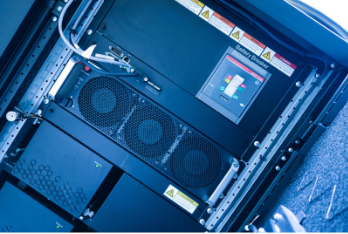
Photo: A modern battery management system inside a cabinet. Research published in the Journal of the Electrochemical Society demonstrated a more accurate battery model that requires less computing power, producing results ten times faster than previous models of the same type. Credit: iStock / Getty Images Plus