
Refined approach for battery arc flash modeling helps to inform appropriate safety controls for battery systems’ installation and maintenance
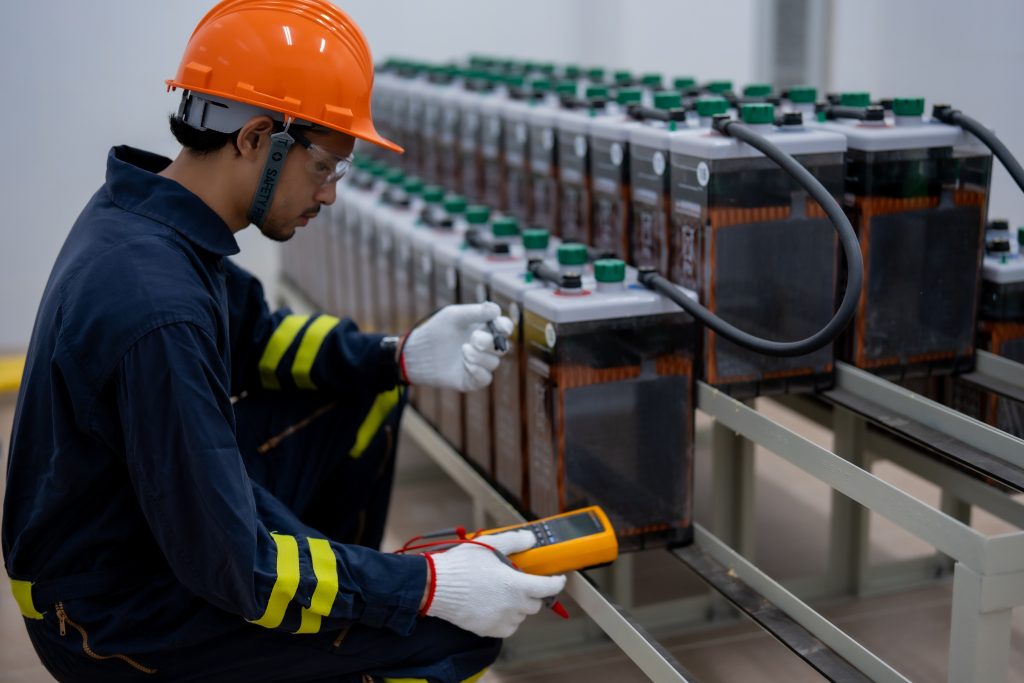
When battery systems are installed or serviced, workers must take precautions to work safely with the systems’ equipment and electricity. These safeguards, which include following specified procedures and wearing personal protective equipment, are typically outlined in standards derived from the system’s design and engineers’ assessment of electrical risk.
At the 2025 IEEE IAS Electrical Safety Workshop, Sandia researcher David Rosewater presented a new model to more accurately model arc flash, an infrequent but severe hazard faced by electrical workers. The paper, titled “Practical Battery Arc Flash Models,” provides a physics-informed, empirical model that accounts for the primary reason traditional modeling methods are so inaccurate: the arc’s duration. By incorporating the critical factor of arc duration, the resulting model can more precisely and practically estimate the likelihood and severity of an arc flash. The resulting estimates can then be used to help assess the risk of arc flash with better accuracy than existing methods.
Accurate risk assessments help establish which safety controls and safeguards are necessary and advisable without becoming overly prescriptive or burdensome. By refining the calculations used for battery arc flash modeling, the research informs safety standards applied to battery work, such as NFPA 70E, supporting systems’ safety and cost-effective deployment in the United States and around the globe.
Released as an open-source tool for ease of use, the new method combines cutting-edge research conducted at the national labs with industry expertise. It uses advanced physics, reapplies mathematical models originally developed for stockbrokers to estimate ‘value-at-risk’, and leverages recently published battery arc flash data. Feedback from workshop attendees praised the approach for its focus on data and applicability.
Since 1991, the IEEE IAS Electrical Safety Workshop has provided a forum to enable and accelerate change in the electrical safety culture to prevent workplace injuries from electrical hazards. Because of the Society’s presentation-first policy for contributing authors, the Electrical Safety Workshop is considered a premier forum for electrical safety research.
To learn more, read the paper “Practical Battery Arc Flash Models,” accessible in the workshop’s proceedings.
This material is based upon work supported by the U.S. Department of Energy, Office of Electricity (OE), Energy Storage Division.