Biological Imaging - Pathogen Detection Tools - Protein Characterization
The development of optical approaches with effective resolutions below the diffraction limit promises to revolutionize the field of biological imaging. We have implemented one such method – Stochastical Optical Reconstruction Microscopy (STORM) for use in studying innate immune signaling. We’ve observed unique TLR4 receptor behavior that may help explain why certain pathogens such as E. coli produce a robust immune response, while others such as Y. pestis (plague) do not, due to the increase in available resolution – down to <50nm. |
|
Although nanomaterials are rapidly being incorporated into an increasing number of consumer products, fundamental knowledge about their interactions with living systems is limited. We have used advanced imaging approaches to understand the role particle shape and size play in determining particle behavior on the cell membrane, as well as their ultimate fate within the cells’ lysosomal machinery. In particular, we observed that particles with higher aspect ratio diffuse much more slowly in cell membranes, and are internalized at a lower rate. |
|
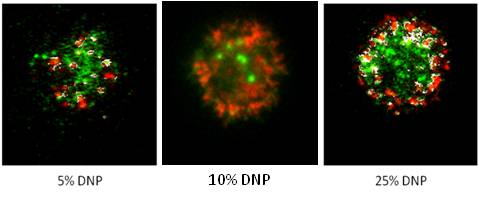
TIRF microscopy offers an ideal method for interrogating interfacial biological phenomena. We are studying the interplay between the IgE signaling pathway and mast cell degranulation, which both occur at the interface between the cell membrane and an external immuno-stimulatory environment. We are currently using RBL cells transfected with a GFP-tagged exocytosis marker (FasL) atop an antigen-containing supported lipid bilayer in order to develop a single cell degranulation assay, and to conduct fundamental research into this process. |
|
 |
Cellular response is determined by dynamic, stepwise interactions of receptor proteins with key membrane proteins. We determined that receptor proteins and signalling is corralled by intracellular cytoskeletal structures. |
Pathogenesis depends on molecular interactions between immune cells and bacteria/viruses. Here, we see virulence proteins accumulate and attack cells only 40 minutes after infection. |
 |
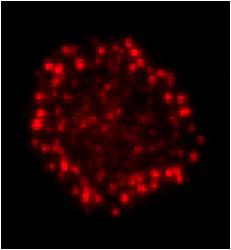
Cholesterol adds membrane firmness and maintains fluidity. In response to ligand binding induced signal transduction, cholesterol forms a punctate structure to regulate membrane properties. |
 Resting |
 Activated |
|
Immune response is governed by pathogen detection and cell to cell communication. Pathogen detection initiates a primary signal while subsequent cell-cell communication represents a secondary signal. In mixed populations, it is impossible to separate primary from secondary signals. We use microfluidics, imaging, and genetic tools to hydrodynamically isolate and interrogate cells. In this case, we observe the translocation of a transcription factor (RelA, green) into the macrophage nucleus, initiating gene transcription as a response to the primary signal only (bacteria in red). In this way, we measure the kinetics and characterize networks of complex interdependent signal transduction pathways. 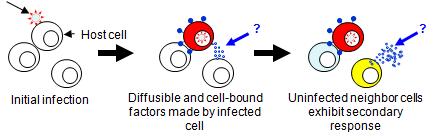 |
||
 |
 |
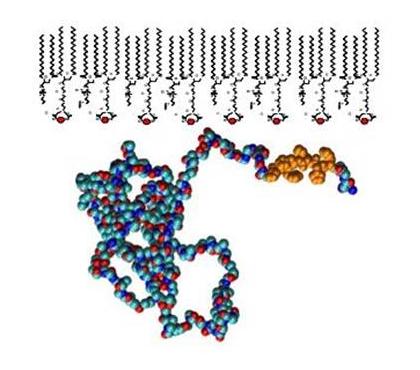 |
Nef is one of six HIV-1 accessory proteins and directly contributes to AIDS progression. Nef associates with membranes and may require a transition from a solution conformation to a membrane-associated conformation. It has been hypothesized that a transition in conformation enables interaction of Nef with cellular proteins. Despite its obvious diseases importance, there is little or no direct information about the conformation of membrane-bound Nef. In this work, we are using neutron reflection to resolve the conformation of membrane-bound Nef and TIRF to study its interaction with cellular proteins. |
|
©1997-2011 Sandia Corporation | Questions and Comments | Privacy and Security |  News release RSS feed