
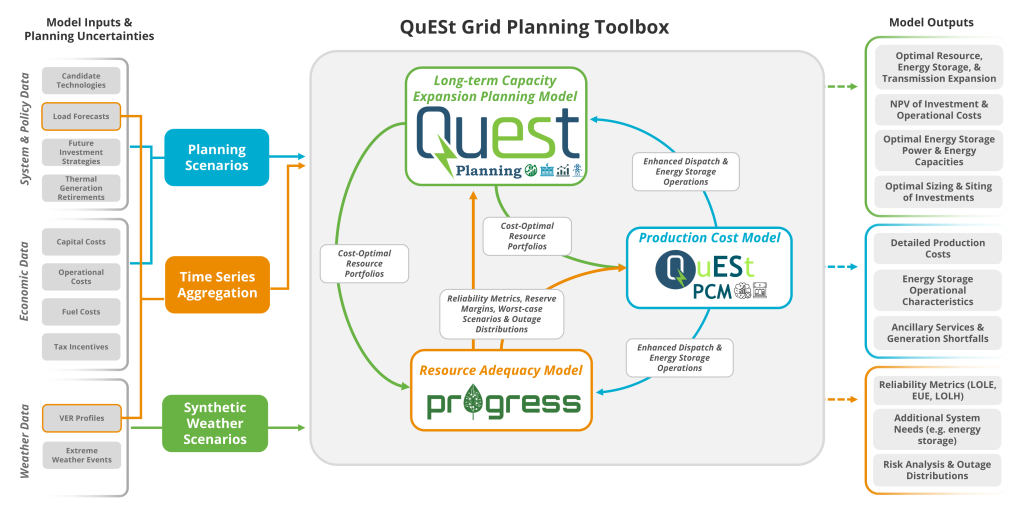
The QuESt Grid Planning Toolbox is an open-source, Python-based suite of tools for grid planning, operations, and reliability analyses with emphasis on energy storage systems. As part of the QuESt 3.0 platform, the toolbox provides centralized access to complementary grid-planning tools that simplify analysis across long-term capacity expansion, production cost, and resource adequacy models. The toolbox includes three primary tools: QuESt Planning, QuESt PCM, and ProGRESS, and the toolbox is visualized below:


QuESt Planning
QuESt Planning is a long-term capacity expansion planning model that identifies cost-optimal investments in energy storage, generation, and transmission. The tool enables users to evaluate a broad range of energy storage technologies, explore alternative planning scenarios and sensitivities, and determine resource portfolios that can meet future power system needs while minimizing investment and operational costs.
QuESt PCM
QuESt PCM is a production cost modeling tool designed to simulate power system operations with high-fidelity representations of energy storage systems. The tool models generation commitment and dispatch, energy storage operations, and participation in day-ahead and real-time electricity markets, enabling users to evaluate system operating costs, storage behavior, ancillary services, and the effects of energy storage on power system operations.
ProGRESS
Probabilistic Grid Reliability Analysis with Energy Storage Systems (ProGRESS) is a Python-based resource adequacy modeling tool for evaluating the reliability of modern electric power systems with high penetrations of energy storage, variable energy resources, and emerging loads. Using stochastic simulation and detailed energy storage models, ProGRESS evaluates uncertainty, component failures and repairs, storage operation, and renewable generation variability to quantify outage risk and other reliability metrics and assess the contribution of energy storage to grid reliability.