On May 5, 2026, Will McNamara from Sandia National Laboratories spoke on a panel at the Battery Council International (BCI) convention in Nashville, TN. The panel focused on battery suppliers and what they need to know about data centers. McNamara shared insights on policies, operations, and interconnection challenges affecting data centers and their battery needs.
Data centers are a booming market for battery energy storage, expected to hit $21 billion in value over the next decade. These facilities demand large amounts of power — some hyperscale data centers request 300 MW to over 1 GW per site. Currently, data centers rely on local utility grids, backup generators, and batteries integrated with uninterruptible power supply (UPS) systems to keep running without interruption. With the power grid facing growing pressures and long delays in connecting new data centers to the grid, operators are looking for power alternatives. Many seek the option to operate in an islanded mode, separate from the grid and using onsite energy storage and generation. This shift is driving demand for new types of batteries that can store energy longer and offer more flexibility than today’s common lithium-ion and lead-acid batteries. McNamara‘s presentation highlighted key federal and state regulatory moves, especially a pending Federal Energy Regulatory Commission (FERC) decision on direct grid interconnection for large power users like data centers (i.e., power use of 20 MW or more). These policies will shape how battery suppliers serve this growing market.
McNamara is a frequent public speaker and leads educational energy storage webinars for state decisionmakers across the U.S.
W. McNamara, “What battery suppliers need to know about data centers,” panelist, Battery Council International Convention, Nashville, TN, May 5, 2026.
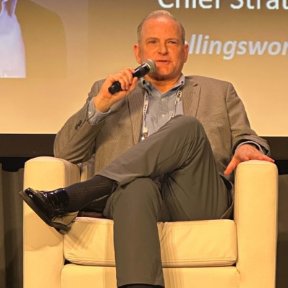
Photo: Will McNamara, technical systems analyst at Sandia National Laboratories, contributes to a panel for battery suppliers at the Battery Council International (BCI) convention in Nashville, TN.
This material is based upon work supported by the U.S. Department of Energy, Office of Electricity (OE), Energy Storage Division.