
Modeling and simulation is the mathematical expression of physical theory. In conjunction with experiments, it represents the range of capabilities normally employed for scientific discovery and operational interrogation. To facilitate the modern application of the scientific method through the integrated use of modeling and simulation with experimentation, fire science researchers at SNL have developed unique facilities, methods, models, and measurement tools.
Who We Are
We have a variety of staff who have experience with simulation analysis, model development, and computational theory who employ a suite of computational tools to support mission critical activities. The computational analysis team works directly with experimentalists to design and interpret fire tests. We draw on an extensive set of simulation tools to support anything from small benchtop parameter studies to large fuel fire predictions. We have the added benefit of being able to work directly with our in-house SIERRA developers to implement desired features in a code. The cycle of work potentially involves models informing experiments, leading to experiments validating models.
Due to some DOE related missions involving the need for quantitative accuracy in model predictions, our in-house codes are designed and maintained to DOE order 414.1D. The code team works to a software quality plan, and the software is regularly audited for compliance to quality control standards. SIERRA/Fuego is export controlled, helping assure the advanced capabilities in the software are not disseminated to people who would use the capability to harm us or our interests.
At the core of most of our analysis work is safety. We are primarily concerned with fire as an operational hazard. We are focused on the risks associated with fire in high hazard operations. We solve high consequence fire problems.
Our Capabilities
Validation
- Validation of our modeling and simulation capabilities provides confidence in the accuracy of the simulations. Sandia has invested in appropriate datasets to quantify accuracies in model simulations for relevant large-scale scenarios. Our test facilities were designed to enable validation experiments, and the modeling team is experienced in performing validation assessments.
- We endeavor to maintain current evidence regarding the simulation accuracy to the relevant datasets.
Model Sensitivity
- We provide more than just predictions, we use models to inform what parameters have high sensitivities. Analysis tools like Dakota can be leveraged to interrogate the physics involved in a computational project and identify physical and model sensitivities.
High Performance Computing
- Access to Sandia’s resource of high-performance computing (HPC) machines enables high-fidelity simulations to be run on complex geometries with reasonable turn-around time
- Full scale CFD models can be run on our unique facilities (FLAME, XTF) with combustion chemistry using the SIERRA/Thermal Fluids tool Fuego.
What Makes Us Unique
- The expertise and experience of the scientists and technologists
- Full-scale to subcomponent level simulation capability
- A focus on DOE, DOD, and related problems of national interest
- Outreach to V&V and UQ groups for quantitative accuracy assessments
- In-house Sierra codes allow for direct model support and development
- Coupled codes providing multi-physics solutions
- Ability to securely handle sensitive (classified or proprietary) models
Thermal-Fluid Modeling And Related Items
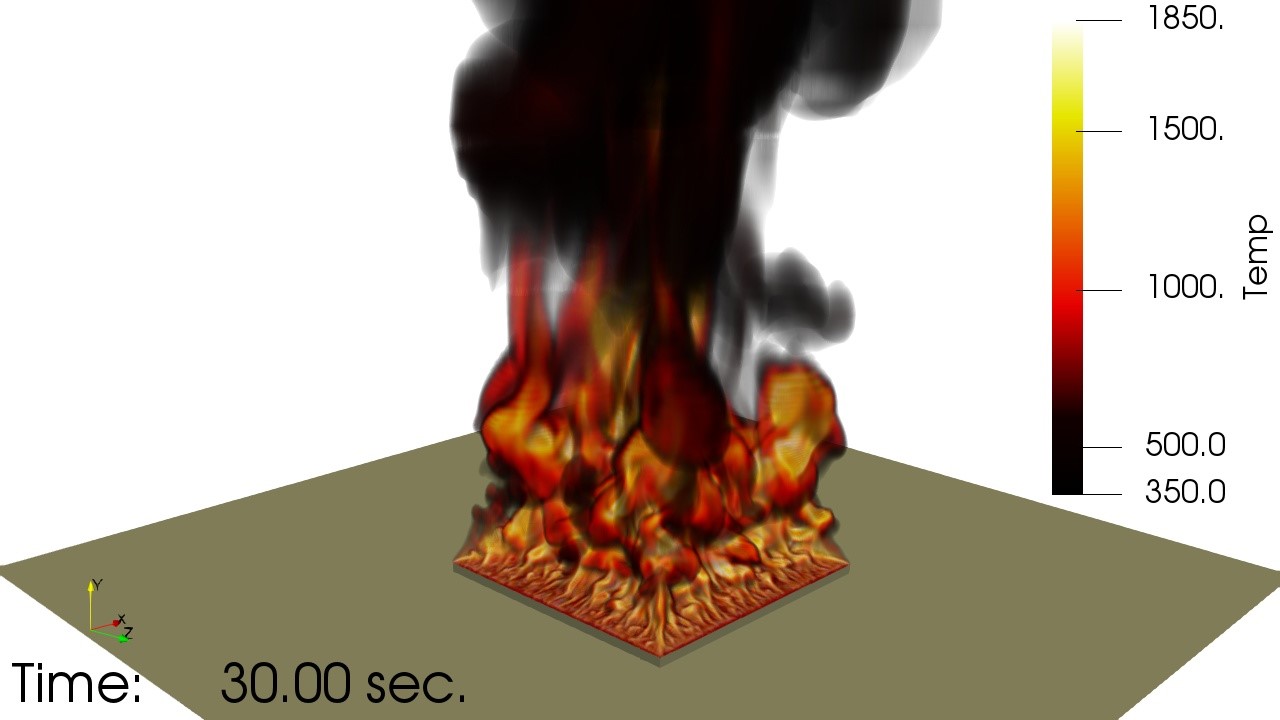
Thermal-fluid modeling takes advantage of many modeling options, with a focus on the Sierra/Thermal-Fluid code suite. This finite-element based, multi-physics computational capability is built upon the Sierra Toolkit framework and takes advantage of Trilinos solver capabilities to enable highly scalable, massively parallel simulation.
- SIERRA/Fuego is a low-Mach number fluid mechanics and heat transfer code.
- Fuego utilizes the NETCDF based Exodus II data structures, and solves the discretized solutions to the Eulerian flow equations on a Control Volume Finite Element Method (CVFEM). Fuego is one of many engineering analysis tools that are built with the SIERRA framework. The SIERRA framework includes advanced solver algorithms and data management tools. It enables coupling between other engineering solver packages.
- Fuego solves the Navier-Stokes equations with turbulence, modeled using either the Reynolds averaged Navier-Stokes (RANS) or large-eddy simulation (LES) approaches. For RANS, a range of turbulence modeling approaches (including k-ε [k-epsilon], k-ω [k-omega] and SST), are available along with buoyancy models based on Rodi, DeRis and the Sandia-developed baroclinic-vorticity generation (BVG) model. Subgrid modeling for LES can be conducted using the Smagorinksi, dynamic-Smagorinski, subgrid kinetic energy (k-SGS) or the dynamic-k-SGS approaches. The Sandia-developed temporally-filtered Navier-Stokes (TFNS) model is also available. Wall models are available to use for convection heat transfer.
- Fuego includes models for reacting flow, based on both the eddy-dissipation concept and mixture-fraction flamelet concepts, as well as customizable unit reactions. Each approach may be extended to allow soot and radiation modeling. The flamelet concepts are extended to multiple mixture fractions, and include heat losses up through flame extinction. More general reacting flow concepts can be implemented using generalized chemical mechanisms, or taking advantage of flamelet models to define arbitrary progress variables.
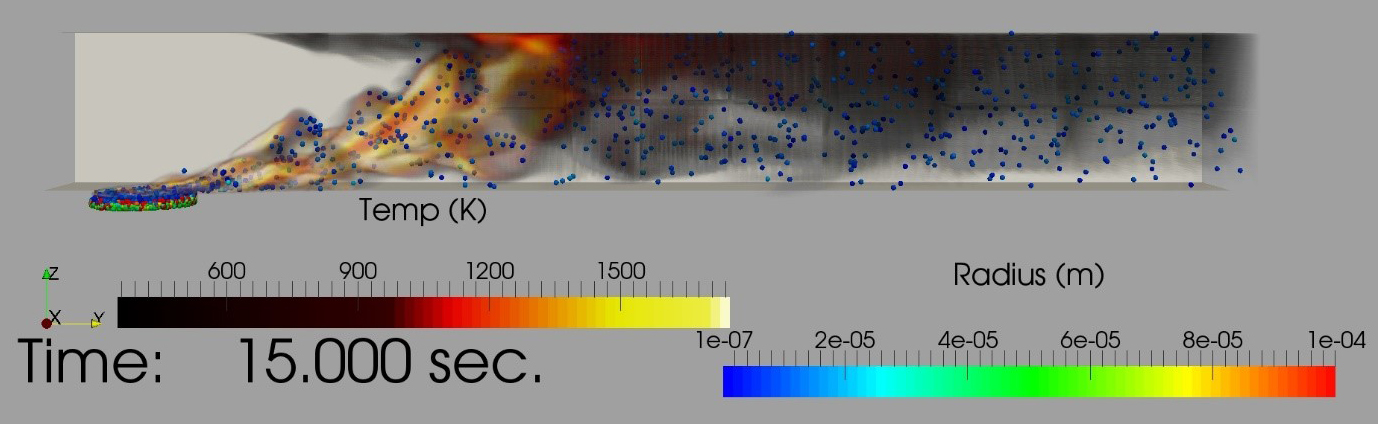
- Fuego includes Lagrangian particle capabilities that allow a range of multi-phase flow simulations including water or fuel sprays, metal particle burning in propellant fires or contaminant transport. Particles can engage in heat and mass transfer with the fluid flow. Particle reactions are handled either in the limit of boundary-layer limited evaporation and condensation (including subgrid scale droplet burning), or on particle surfaces and internal to particles, taking advantage of the general chemical mechanism capabilities.
- Fuego includes a volume-of-fluid model to allow simulation of another class of multi-phase flow problems with surfaces that can be resolved on the simulation scale.
- Radiation transport can be significant in fires, and normally requires costly approximations to resolve participating media scenarios involving semi-transparency. To predict radiation transport in participating media (fires, sprays, etc.), SIERRA/Syrinx employs a scalable computational approximation to solving the radiative transport equation using a discrete-ordinates approach and a gray model for the radiation interactions. Syrinx is generally run coupled with Fuego, where Fuego provides the prediction of the temperature and absorption coefficients to Syrinx, while Syrinx computes the radiative source terms for the enthalpy equation in Fuego.
- Sceptre is a new addition as of 2017 to the thermal fluids code suite, providing an expanded range of radiative transfer equation modeling approaches. Sceptre brings additional solver options and non-gray capability. It also allows for greater solver flexibility to better customize the allocation of computational resources to the fluid versus the radiation equations.
SIERRA/Aria provides the primary unsteady thermal analysis capabilities within the Sierra/TF code suite. Aria is generally coupled to Fuego to determine thermal response of objects in fire environments. Conjugate analysis of fire and thermal response is the primary reason Aria and Fuego are coupled. Aria includes limited fluid modeling capabilities, particularly for low Reynolds number scenarios, including porous media.
Other specific capabilities available in Aria include:
- General reacting material capabilities within the constraints of low Reynolds number or fixed media. The evolution of solid-reacting materials, including solid fuels, can be handled using this capability. The internal thermochemical evolution of battery thermal runaway is conducted using Aria
- Porous material evolution and transport, including Darcy’s law and a range of interphase coupling models
- Anisotropic heat and mass transfer
- Enclosure radiation (non-participating media)
SIERRA/Presto is a finite element structural dynamics code for simulating impacts and impulse deformations in designed systems. We couple Presto with Fuego to simulate impact and impulse dispersed liquids and aerosols to assess dispersion and fire consequences from this class of scenario.