griDNA is designed to protect distributed critical infrastructure systems such as power grids, pipelines, and transportation networks against disruptions caused by cyber-attacks or system failures. The technology continuously gathers and analyzes system data alerting operators and defenders with early detection of abnormal behavior that signals potential trouble, whether it stems from inadvertent equipment failures or malicious cyber attacks.
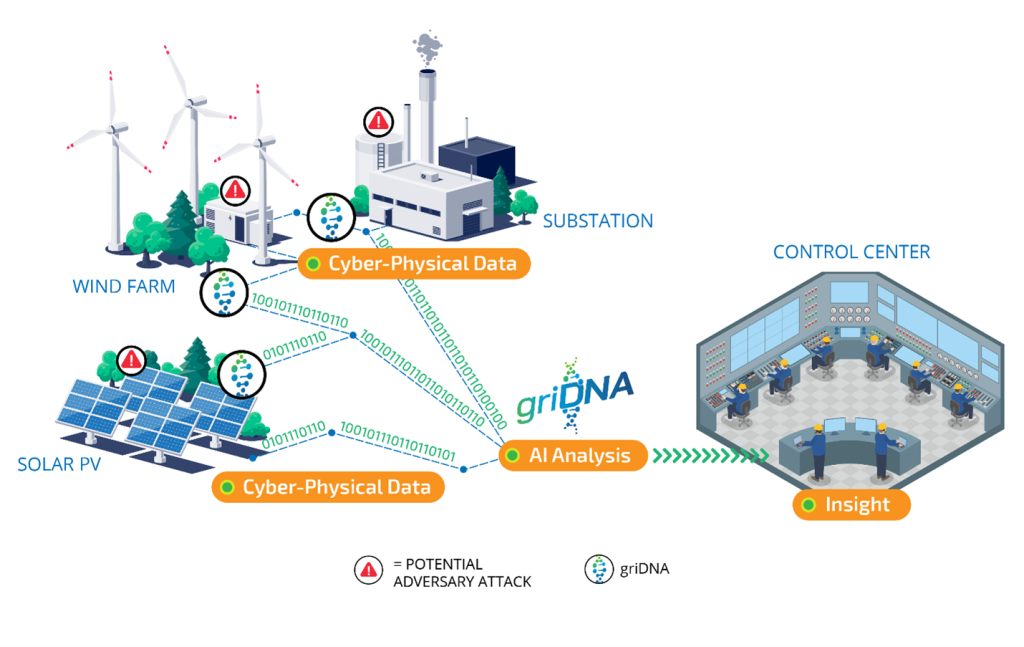


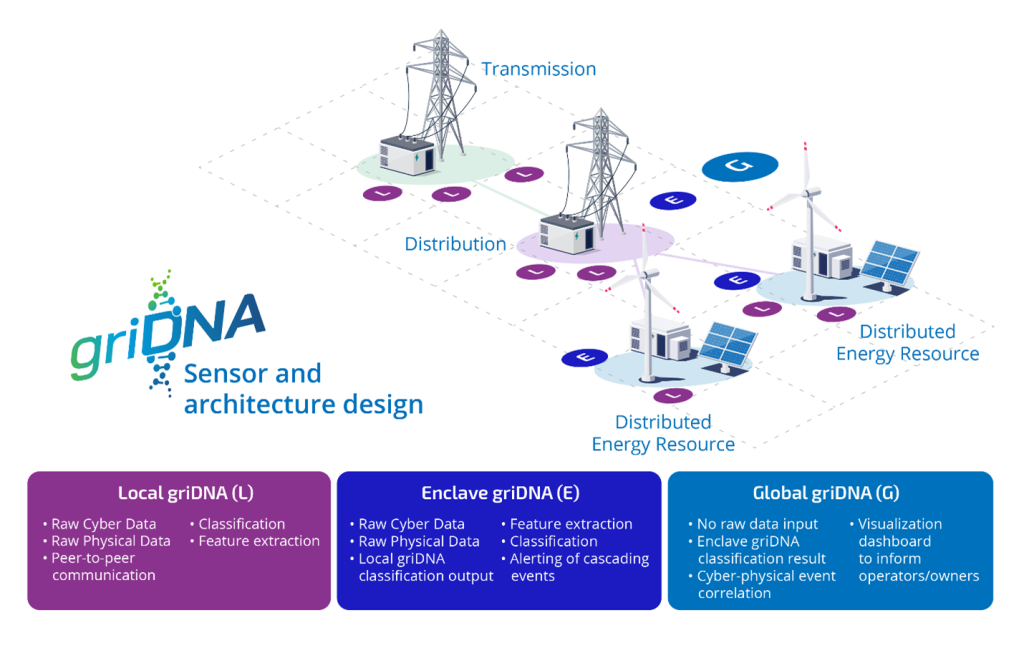
The technology provides system operators and defenders with a deeply informative and multi-level cyber-physical situational awareness (CPSA). The collected data represent the infrastructure’s physical (physics-based) processes as well as the cyber network activity supporting the system. Data gathering and analysis is also strategically structured to retrieve information at the “local” level of individual components, the “enclave” level of subsidiary networks, and the “global” level of multiple, interconnected systems. Thus, griDNA is uniquely suitable for monitoring and detection within distributed and interconnected critical infrastructure systems through its flexible granularities.
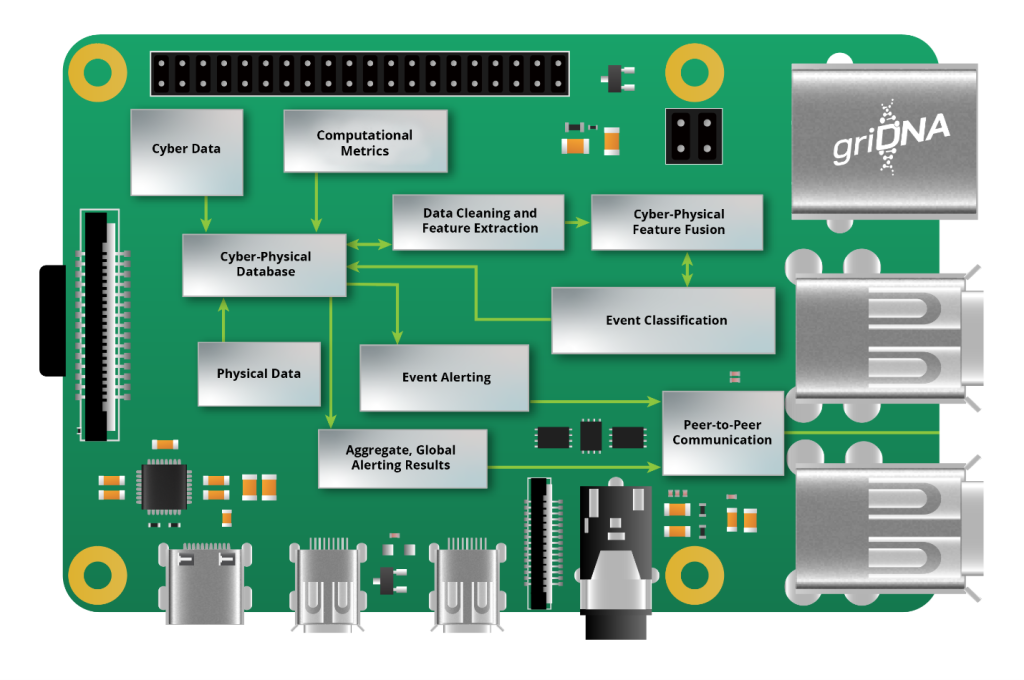
These data sets are correlated and analyzed using advanced data fusion and artificial intelligence (AI) techniques. The AI analysis, specifically autoencoder neural networks, identifies patterns in the cyber-physical interdependencies and can be used to characterize the expected system behavior.
The technology’s cyber-physical system characterization not only bolsters critical infrastructure cybersecurity and resilience but can also be used to improve planning (e.g., which parts of the system require more redundancy) as well as operation (e.g., certain critical control components are impacted by communication latency delays). While griDNA has been developed with the electric grid application, it can be extended to any critical infrastructure system that relies on physics-based processes and operational networking.
TRL: 8
Market sheet
Correction: TRL 8
R&D 100 Finalist
griDNA is an R&D 100 (2025) finalist.
Read about it on R&D World.
- Cordeiro et al., “Considerations for Secure Data Exchange to Achieve Cyber-Physical Situational Awareness in the Electric Grid,” Power and Energy Conference at Illinois 2023, SAND2023-11678C, 2023.
- Haque et al., “Multimodal learning in Cyber-Physical System: A Deep Dive with WSCC 9-Bus System,” 2024 Innovative Smart Grid Technologies, 2024.
- Blakely et al., “A Comparison Study of Feature Extraction and Data Fusion Techniques for Improving Cyber-Physical Situational Awareness,” 2024 IEEE T&D Conference, 2024.
- Reyna et al., “Towards the Design of Cyber-Physical Integrated Security Operations Center Visualizations,” 2024 Kansas Power and Energy Conference, 2024.
- Fragkos et al., “Cyber-Physical Data Fusion & Threat Detection with LSTM-Based Autoencoders in the Grid,” 2024 Kansas Power and Energy Conference, 2024.
- Cordeiro et al., “Design for Secure and Resilient Data Exchange Across Distributed Cyber-Physical Sensors and Analytics in Decentralized Energy Systems,” 2025 Hawaii International Conference on System Sciences (HICSS), 2025.
Sandia researchers build AI system to detect anomalies across the electrical grid
Albuquerque Journal
September 13, 2025
Sandia Labs has enlisted AI for electric grid protection
Sandia Lab News
September 9, 2025
Protecting the grid with artificial intelligence
KOAT Action News
September 4, 2025
R&D 100 finalist: Sandia’s griDNA flags cyber-physical grid anomalies at the edge
R&D World
September 4, 2025
Commercial and Partnership Opportunities
The griDNA team is looking for commercial partners who are interested in licensing the technology.
The griDNA team is seeking any pilot/field testing or sample data opportunities with critical infrastructure stakeholders who are seeking technologies to achieve cyber-physical situational awareness and breaking down siloes between cyber defenders and system operators.
The Team




Adrian Chavez
Jess Robinson
Taylor Collins
The Partners

Texas A&M

Sierra Nevada Corporation