

Erik Webb testifies before Congress on fossil energy research
Sandia geoscience research and application senior manager Erik Webb provided testimony before the U.S. House of Representatives Committee on Science, Space, and Technology in Washington, D.C., on June 19. Erik’s testimony focused on the importance of fossil energy research.
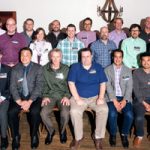
Praising Sandia’s culture of innovation
Sandia hosted its annual Innovation Celebrations in Livermore and Albuquerque May 16 to recognize the Labs' innovators. The celebration honored individuals who received patents, copyrights or licensed royalties, or created other intellectual property in 2018.
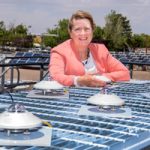
Global collaboration to study photovoltaic performance, reliability
An international community of research institutions, led by Sandia, to advance photovoltaic research and expand solar markets formally launched its work on May 14 in Munich, Germany. The organization provides a unique platform for studying photovoltaic performance and reliability in multiple, diverse environments and climates.
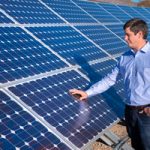
Rooftop solar panels get boost from Sandia tool
Homeowners and businesses may now have an easier time getting solar panels on rooftops thanks to software developed at Sandia. The new software can run a detailed, second-by-second simulation that shows utility companies how rooftop solar panels at a specific house or business would interact with a local electrical grid throughout the year.
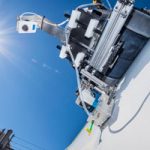
Don’t set it and forget it — scan it and fix it with tech that detects wind blade damage
Drones and crawling robots outfitted with special scanning technology could help wind blades stay in service longer, which may help lower the cost of wind energy at a time when blades are getting bigger, pricier and harder to transport, Sandia researchers say.
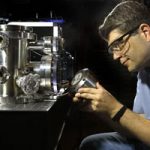
New look at old data leads to cleaner engines
New insights about how to understand and ultimately control the chemistry of ignition behavior and pollutant formation have been discovered in research led by Sandia. The discovery eventually will lead to cleaner, more efficient internal combustion engines.
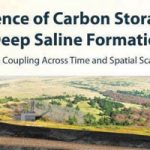
Sandia author examines carbon storage in deep saline formations
A new book co-authored and co-edited by Sandia experimental geochemist Anastasia Ilgen provides a comprehensive look at carbon storage in deep saline formations. The volume, published by Elsevier, is entitled Science of carbon storage in deep saline formations: Process coupling across time and spatial scales.
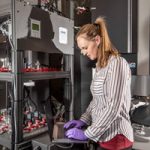
Thwarting oil-pipeline corrosion by identifying nanoscale villains
Researchers at Sandia, the DOE Center for Integrated Nanotechnologies and the Aramco Research Center in Boston have found that a particular form of nanoscale corrosion can cause variations in material longevity that unpredictably decrease the working life of steel pipes.
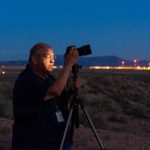
A day in the life of Sandia — 70 years and counting
To mark the 70th anniversary of President Truman’s letter that inspired Sandia to “… exceptional service,” Lab News photographer Randy Montoya spent a full day chronicling the people and work that make the Labs hum from sun up to sundown.
Building health through better buildings
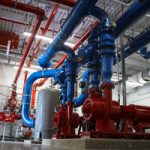
Sandia is the first corporate campus to receive the new Building Health Leadership Award, which recognizes its Leadership in Energy and Environmental Design v.4 Campus effort. Sandia is the largest DOE site named a LEED v.4 Campus.