3.2.4.19. Level Set
The level set method resolves evolving interfaces between multiple phases within
a domain; this is done by tracking a smooth signed distance function
 over the domain that indicates the closest distance to the
interface at any point. An example of a function is given for
a 2D circular interface (
over the domain that indicates the closest distance to the
interface at any point. An example of a function is given for
a 2D circular interface ( ), is shown in
Fig. 3.2
), is shown in
Fig. 3.2
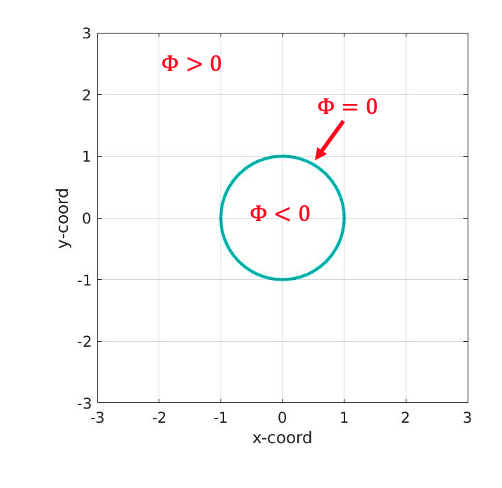
Fig. 3.2 Schematic of 2D circular interface using a signed distance function
As seen in Fig. 3.2, values where  indicate
one phase, and
indicate
one phase, and  indicates another; the interface separating the
two phases is represented by the
indicates another; the interface separating the
two phases is represented by the  isocontour. Geometric parameters such as the
interface normal
isocontour. Geometric parameters such as the
interface normal  and curvature
  can be calculated
directly from since it is a smooth function:
can be calculated
directly from since it is a smooth function:
(3.88)
An important property of is that it remains a signed distance
function; this ensures that the computations in (3.88) are accurate.
This property is enforced by ensuring the norm of the gradient of is equal to 1:
(3.89)
The variable is
typically advected with the fluid velocity  , which is obtained from the solution
of (3.22):
, which is obtained from the solution
of (3.22):
(3.90)
In general, Eq. (3.90) does not satisfy the property posed
by Eq. (3.89). An additional redistancing operation must be
performed throughout the simulation, which will be discussed in Level Set/CDFEM.
Aria allows the user to define generic sources  to model any
sinks/production rates into the level set field, thus
(3.90) is modified to:
to model any
sinks/production rates into the level set field, thus
(3.90) is modified to:
(3.91)