
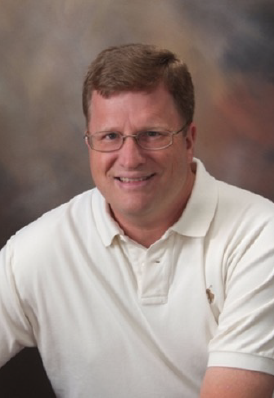
The S. Scott Collis Fellowship in Data Science is a prestigious postdoctoral fellowship that provides opportunities for highly motivated researchers to address challenging problems in national security applications. Scott Collis was the director of Sandia’s Center for Computing Research from 2017 to 2022. Due in large part to his recognition of and advocacy for data science as a pivotal research area for impacting problems of national importance, the Sandia Data Science Postdoctoral Fellowship was created in 2021 to attract the best and brightest postdoctoral researchers in data science. The fellowship was renamed the S. Scott Collis Fellowship in Data Science in honor of Scott, who passed away in 2022 after battling cancer. Scott’s vision will continue to be carried out through the innovative research of selected fellows working at the intersection of academic excellence and impactful applications.
Collis Fellows pursue a combination of both self-directed research in topic areas that they select, and integration with existing Sandia R&D projects, all under the guidance of Sandia staff mentors. Collis Fellows are expected to publish the results of their work in leading journals and present research at top-tier conferences. Selected Fellows will receive a two-year appointment with the potential option for a third year, which includes a highly competitive salary, moving expenses, and a generous professional travel allowance.
Sandia National Laboratories is dedicated to nurturing a culture compatible with a broad group of people and perspectives. Consistent with this dedication, we seek applicants from a wide range of backgrounds, and we foster a research community of belonging.
Application process
Applicants should submit a one- or two-page summary, excluding references, of a data science research problem and proposed approach. We are interested in understanding the types of problems, data, and techniques that candidates hope to pursue during a potential fellowship. Insights into how the proposed work may relate to national security problems are welcomed but not required. If selected for the fellowship, the candidate will work with a Sandia staff mentor to align the proposed work to Sandia’s mission needs and expand the summary into a formal proposal for the funding that will support the next two years of their research at half-time. The other half of the selected fellow’s time will come from an existing Sandia R&D project, giving the fellow the opportunity to collaborate on a research team.
- Read the complete Fellowship job description, including required and desired applicant qualifications.
- Submit a single PDF file containing your cover letter, CV, and a 1-2 page research proposal when applying to Job ID 698738
- Have three letters of recommendation sent to datasciencefellow@sandia.gov with “Collis DS Fellowship” as the subject line.
Current Collis Fellows in Data Science
Eduardo Ortega, 2026 Collis Fellow
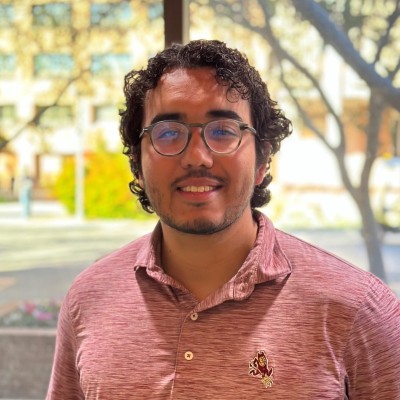
Eduardo Ortega is the S. Scott Collis Postdoctoral Fellow in the Scalable
Computer Architecture group at Sandia National Laboratories. His work focuses
on scalable resilient computing. His research interests lie at the intersection of
hardware and software for system-level robustness with a focus on efficiency and
scalability. His PhD dissertation focuses on lifecycle robustness and scalability throughout the computational stack, delving into a range of topics from circuits,
systems, to machine learning. He received his B.S./B.A. degree in Integrated
Engineering from the University of San Diego and his M.S./Ph/D in Computer
Engineering from Arizona State University (ASU).
During his Ph.D., Eduardo completed internships with Synopsys, Intel (x2), and Sandia National Labs. Eduardo has been awarded as the 2021 Sloan Scholar, 2022 National Science Fellow Graduate Honorable Mention, 2023 Fulton Fellow, 2023 Semiconductor Research Corporation TechCon Outstanding PhD presenter, 3x ASU outstanding research award winner, 2023 IEEE CAI Best Paper Nominee, 2x TVLSI impactful article, 2024 ASU ECEE outstanding graduate researcher, 2025 Qualcomm Innovation Fellowship runner-up, and the 2025 IEEE Circuits and Systems Society’s Outstanding Young Author.
As a S. Scott Collis Fellow, Eduardo is broadly interested in developing anomaly driven
monitoring systems to aid in runtime performance or quality control. With this project, he will develop and evaluate kernel-based learning methods for scalable image-based anomaly detection. The target application use-case is a resource-efficient anomaly detection to work in-situ for additive manufacturing process. Conventional deep-learning approaches, such as neural networks, typically require large datasets to learn and generalize effectively. In contrast, kernel-based methods can perform well in data-scarce, low-sample regimes. By leveraging existing kernel methods and developing new kernel similarity techniques, his work will construct unsupervised representations of known-good manufacturing processes. These “golden” process representations can then be compared with deployed processes at scale to assess manufacturing quality in
existing and emerging products.
Camden Elliott-Williams, 2025 Collis Fellow

Camden Elliott-Williams is a S. Scott Collis Data Science Fellow in the Machine Intelligence and Visualization department. His interdisciplinary research delves into understanding and optimizing complex systems, leveraging concepts from artificial intelligence, number theory, statistical modeling, algorithmic game theory, cognitive psychology, and related fields. His PhD dissertation explored task-specific image modulations to enhance human perception, with a focus on assisting vision limitations such as color vision deficiency and blurry vision. Prior to his graduate degrees, Camden worked as a research mathematician for the U.S. Government in areas including algorithm development, data science, and high-performance computing applications.
Camden’s Fellowship project will explore active selection methods to support a range of Sandia mission applications involving scientific discovery or improved decision making.